<?xml version="1.0" encoding="utf-8"?><feed xmlns="http://www.w3.org/2005/Atom" ><generator uri="https://jekyllrb.com/" version="4.3.4">Jekyll</generator><link href="https://www.lakruzz.com/feed.xml" rel="self" type="application/atom+xml" /><link href="https://www.lakruzz.com/" rel="alternate" type="text/html" /><updated>2026-09-06T13:21:14+00:00</updated><id>https://www.lakruzz.com/feed.xml</id><title type="html">Lakruzz</title><subtitle>Lakruzz</subtitle><author><name>Lars Kruse</name></author><entry><title type="html">Et blindt øje til AI — fører til samfundsstrukturel systemfejl</title><link href="https://www.lakruzz.com/stories/ai-systemfejl/" rel="alternate" type="text/html" title="Et blindt øje til AI — fører til samfundsstrukturel systemfejl" /><published>2026-04-11T00:00:00+00:00</published><updated>2026-04-11T00:00:00+00:00</updated><id>https://www.lakruzz.com/stories/ai-systemfejl</id><content type="html" xml:base="https://www.lakruzz.com/stories/ai-systemfejl/"><![CDATA[<div class="pic caption pic center large">
  
  
  <a href="/assets/images/posts/systemfejl.png">
    
    <img src="/assets/responsive/1020/systemfejl.png" srcset="/assets/responsive/128/systemfejl.png 128w,/assets/responsive/255/systemfejl.png 255w,/assets/responsive/510/systemfejl.png 510w,/assets/responsive/1020/systemfejl.png 1020w," alt="Dual scenario" class="pic pic center large" /></a></div>

<p class="kicker">Der virker til at være generel enighed blandt de politiske partier om at en uniform kilde til velfærdsstatens success er… <em>“Vi må øge arbejdsudbuddet!”</em> Logikken er, at samfundskagen skal være større, så vi kan beskatte flere lønmodtagerindkomster, så folk bruger flere penge og dermed betale mere i MOMS på varer.</p>

<p>Ifølge de nyeste tal (herunder Skatteøkonomisk Redegørelse 2025) ser fordelingen af statens samlede skatteindtægter (2025-skøn, ca. 1.345 mia. kr.) således ud:</p>

<p>💰 <strong>Indkomstskat</strong>: 52% (Inkl. bundskat, topskat og kommuneskat)<br />
🛒 <strong>Moms</strong>: 21% (Afgiften på vores allesammens forbrug)<br />
🛠 <strong>Arbejdsmarkedsbidrag</strong>: 9% (Den flade skat på 8% af al løn)<br />
🏢 <strong>Selskabsskat</strong>: 9% (Skat på virksomhedernes overskud)<br />
🚗 <strong>Øvrige afgifter</strong>: 9% (El, benzin, tobak, biler og ejendomsskat)</p>

<p>Den skrøbelige samfundskonstruktion som entydigt “går efter” lønarbejde og MOMS betyder at: ~82% af statens indtægter er direkte afhængige af, at folk er i arbejde og har en løn at (for)bruge med MOMS indtægter til følge! Så det er klart at politikerne messer som et mantra:</p>

<blockquote>
  <p><em>“Vi må øge arbejdsudbuddet”</em></p>
</blockquote>

<h2 id="ai--og-samfundskagen">AI — og samfundskagen</h2>

<p>AI er på få år modnet fra blot at være undeholdende chat bots til at fungere som overbevisende problemløsere i Agentic mode (agere selv, uden styring) og vi står nu på tæsklen til at release AGI — Artificial General Intelligence.</p>

<p>Udviklingen i AI revolutionen følger ikke en lineær kurve, men en stejl eksponentiel kurve. Et konservativt gæt på hvordan fremtiden tegner sig kunne være:</p>

<p><strong>2023-2025 “Prompt Era”</strong>: AI var som en lærd papegøje. Den svarede kun, når man talte til den. Den kunne skrive et digt eller opsummere en PDF, men den kunne ikke “gå i gang” med et arbejde selvstændigt.</p>

<p><strong>2026-2027 “Agentic Era”</strong>: (Der hvor vi er nu) AI er ikke længere bare en chatbot, men agenter, der kan planlægge og udføre komplekse opgaver over dage (f.eks. kode en hel app eller køre en marketingkampagne autonomt).</p>

<p><strong>2028-2029 Teknisk Artificial General Intelligence (AGI)</strong>: Mange førende laboratorier (OpenAI, Anthropic, DeepMind…) forventes at demonstrere systemer, der matcher eller overgår menneskeligt niveau på tværs af alle kognitive opgaver, inklusive ræsonnement og videnskabelig opdagelse.</p>

<p><strong>2030-2032: Almindelig AGI tilgængelighed</strong>: Her bliver AGI hverdagseje. Det er integreret i operativsystemer og virksomhedsstrukturer. “The Rise Of The Machines”</p>

<p class="fact right medium"><strong>April 2026</strong> — Anthropic har netop valgt at tilbageholde deres fulde Claude Mythos-model fra offentligheden. Begrundelsen gik på, at modellen viste sig at være så god til at finde og sammenkæde ukendte sårbarheder i alt fra browsers til kritisk infrastruktur, at de vurderede, det ville svare til at give alle en digital atombombe. Samt at den udviser en evne til autonom planlægning, som vi ikke har set før. Den “gætter” ikke bare ord; den lægger strategier.
<br /></p>

<p>Måske var Anthropic’s nylige udmeldingen omkring Claud Mythos et hoax — eftersom ingen andre end Anthropic endnu ved hvad Claude Mythos kan er det stadig muligt — nogle uger endnu — at afskrive det som en hype og marketingspekulation. Men det er overvejende sandsynligt at tidsforudsigelserne ovenfor er meget konservative.</p>

<p>Agentic AGI rammer os måske allerede i 2026.</p>

<h2 id="arbejdsudbuddet-stiger-men-ai-gør-balancen-på-arbejdsmarkedet-skæv">Arbejdsudbuddet stiger, men AI gør balancen på arbejdsmarkedet skæv</h2>

<p>…og samfundskagen bliver samlet set mindre.</p>

<p>I økonomisk forstand er arbejdsudbuddet det samlede antal timer, befolkningen stiller til rådighed for arbejdsmarkedet. Forholdet mellem udbud og behov, kaldes <em>balancen på arbejdsmarkedet</em>. Hvis udbuddet stiger, uden at efterspørgslen følger med, får vi ubalance og arbejdsløshed.</p>

<p>At øge arbejdsudbuddet giver kun mening i en tid med efterspørgsel på arbejdskraft. I tider med arbejdsløshed vil det være som at hælde vand i et allerede fyldt kar.</p>

<p>Det er komplet uforudsigeligt hvor mange velbetalte vidensarbejdere, som reelt vil blive arbejdsløse med Agentic AGI men det er mest realistisk, at der vil være tale om <em>mange</em> mennesker. Vel at mærke mennesker i fag som vi hidtil aldrig før har forbundet med arbejdsløshed, mennesker med de højeste indkomster i vores samfund, som driver de store indtægter til staten på lønarbejde og det store forbrug og dermed MOMS-indtægter.</p>

<p>Mange virksomheder har allerede gjort tiltag til afskedigelser begrundet i AI og mange andre er stoppet med at tage junior- og studentermedarbejdere ind. Aldersdiskrimination på arbejdsmarkedet starter allerede i 40’erne.</p>

<h2 id="politisk-automat-tænkning-vender-det-blinde-øje-til-ai-revolutionen">Politisk “automat-tænkning” vender det blinde øje til AI-revolutionen</h2>

<p>Dansk politik kører i høj grad kører efter en model, der blev støbt i 90’erne og 00’erne. Logikken er:</p>

<blockquote>
  <p><em>Vi mangler hænder til velfærd og produktion → vi skal have folk til at arbejde mere og længere → det skaber vækst.</em></p>
</blockquote>

<p><strong>Den blinde vinkel</strong>: De fleste økonomiske modeller (som dem Finansministeriet bruger) antager, at teknologi skaber flere job, end den nedlægger. Det skete under industrialiseringen, og det skete med computeren, internettet, SoMe…. Men Agentic AI er anderledes, fordi den ikke bare er et værktøj, men en “kollega”, der kan udføre autonomt arbejde.</p>

<p><strong>Akademisk arbejdsløshed</strong>: Hvis AI overtager opgaverne for vidensarbejdere, risikerer vi as stå med en overkapacitet af højtlønnede vidensarbejdere. I det scenarie vil politiske tiltag for at øge udbuddet (f.eks. ved at skære i dimittendsatsen eller hæve pensionsalderen) være uden effekt — overhovedet.</p>

<p>Risikoen, eller blot potentialet for AI-induceret massearbejdsløshed fylder meget lidt i den politiske debat. Hvorfor reagere Politikerne ikke?</p>

<p><strong>Forsinkelse i data</strong>: Politikere reagerer på statistikker, og indtil videre er beskæftigelsen rekordhøj. De ser røgen (AI-nyhederne), men de ser endnu ikke branden i arbejdsløshedstallene — endnu.</p>

<p><strong>Uforudsigelighed</strong>: Ingen ved præcis, hvornår Agentic AGI knækker koden til at erstatte hele arbejdsflow. Det kan forekomme nytteløst for en gennemsnitspolitiker at føre politik på noget, der måske sker om 2 eller 7 år.</p>

<p><strong>Strukturelt håb</strong>: Man lukker øjnene og håber på, at de overflødige akademikere kan omskoles til de sektorer, der i dag skriger på folk. Men aldersdiskrimination og lønnedgang er enorme barrierer, som kommer til at ramme som trafikuheld i høj fart. Desuden er det i høj grad i offentlige (omsorgs)erhverv der mangler folk. Det er traditionelt arbejde der skal betales af det offentligt — altså en stor samfundskage.</p>

<h2 id="uddannelsepolitik-fra-00erne">Uddannelsepolitik fra 00’erne</h2>

<p>Hvis man <em>tror på</em> at arbejdsløshed aldrig vil indtræde igen, så er det at øge arbejdsudbuddet er helt sikkert en farbar løsningen til vækst. Så virker det logisk at holder det politiske system fast i en strategi, der har været dominerende siden 00’erne — <em>“Uddannelse er svaret på alt vækst.”</em></p>

<p>Politikerne har historisk set, betragtet uddannelse som en forsikring mod arbejdsløshed. Logikken er: <em>Jo højere uddannelse, jo mere immun er du over for automatisering</em>. Men AGI vender denne pyramide på hovedet:</p>

<p><strong>Før</strong>: Robotter overtog det manuelle arbejde (løsning: mere akademisk uddannelse).</p>

<p><strong>Nu</strong>: AI overtager det kognitive arbejde. Det betyder, at staten lige nu investerer milliarder i at uddanne folk til funktioner, som en AGI-agent kan udføre hurtigere og billigere, før de studerende overhovedet er færdige med deres uddannelse.</p>

<h2 id="kompetence-mismatch">Kompetence-mismatch</h2>

<p>Vi ser allerede nu i 2026 et voksende skel:</p>

<p><strong>Høj efterspørgsel</strong>: På folk der kan udføre opgaver, der kræver fysisk tilstedeværelse og høj menneskelig empati (velfærdens kerne).</p>

<p><strong>Overskud</strong>: På den klassiske akademiske vidensarbejder, der lever af at indsamle, analysere, udvikle og formidle information – præcis det, AI gør bedst.</p>

<p>Det største problem med “uddannelse som løsning” er hastigheden:</p>

<p>Det tager 5-7 år at producere en akademiker. Men En AI-model fordobler sin formåen på 6-12 måneder.</p>

<p>Politikerne fører en “lineær politik” i en “eksponentiel verden”.</p>

<h2 id="systemfejl-i-dansk-politik">Systemfejl i dansk politik</h2>

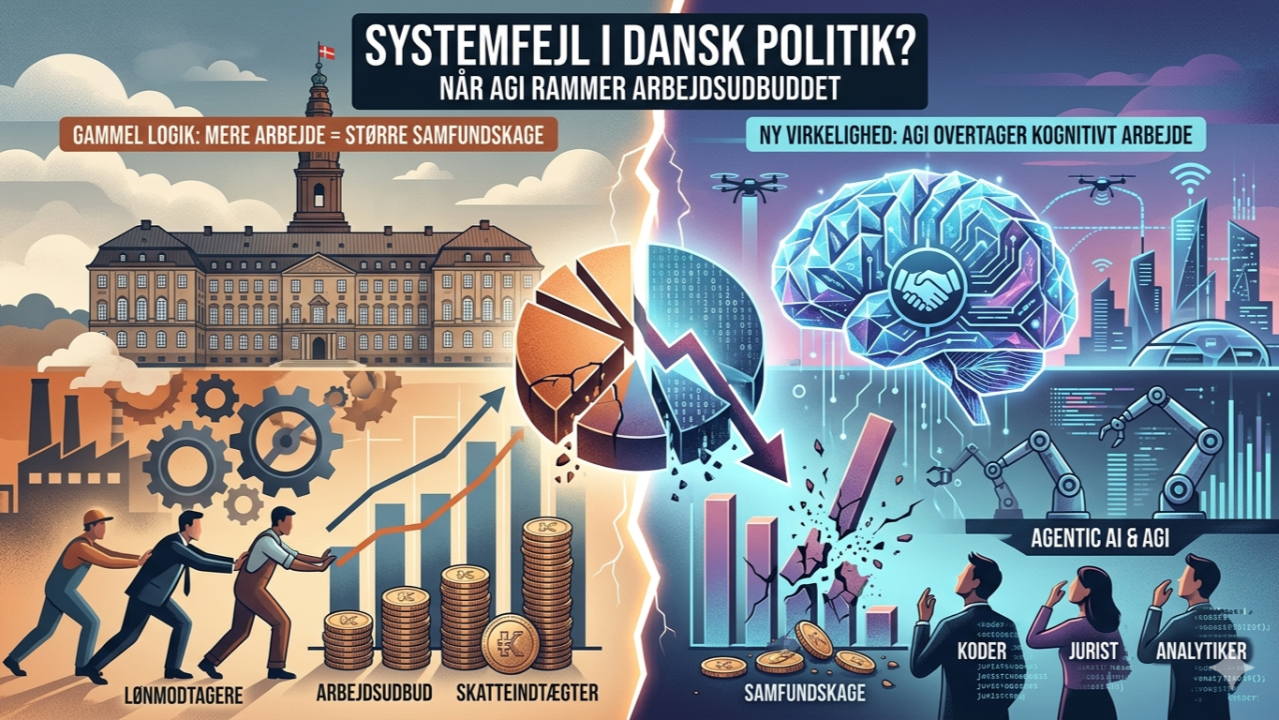
<p>Der er en overhængende risiko for, at vi bliver ofre for en systemfejl i dansk politik. Mens Christiansborg kæmper for at skaffe flere hænder til den “gamle” verden for at øge sine indtægter og bage en større samfundskage, gennem af føre en bedaget arbejdsmarkedspolitik og uddannelsespolitik. så kan AI være i gang med at gøre titusindvis (hundredetusindvis?) af hænder overflødige i den “nye” verden — bare i Danmark.</p>

<p>Hvis vi ender i et scenarie med høj ufrivillig stigning i udbuddet altså arbejdsløshed blandt vidensarbejdere, vil diskussionen på et tidspunkt skifte fra <em>“hvordan får vi folk til at arbejde mere”</em> til <em>“hvordan finansierer vi et samfund, hvor maskinerne laver arbejdet”</em> (f.eks. borgerløn eller robotbeskatning). Men der er vi slet ikke i den nuværende politiske debat endnu.</p>

<h2 id="er-det-en-reel-bekymring--hvad-tror-du">Er det en reel bekymring? — Hvad tror du?</h2>

<div class="pic caption pic center medium">
  
  
  <a href="/assets/images/posts/dual-scenario.png">
    
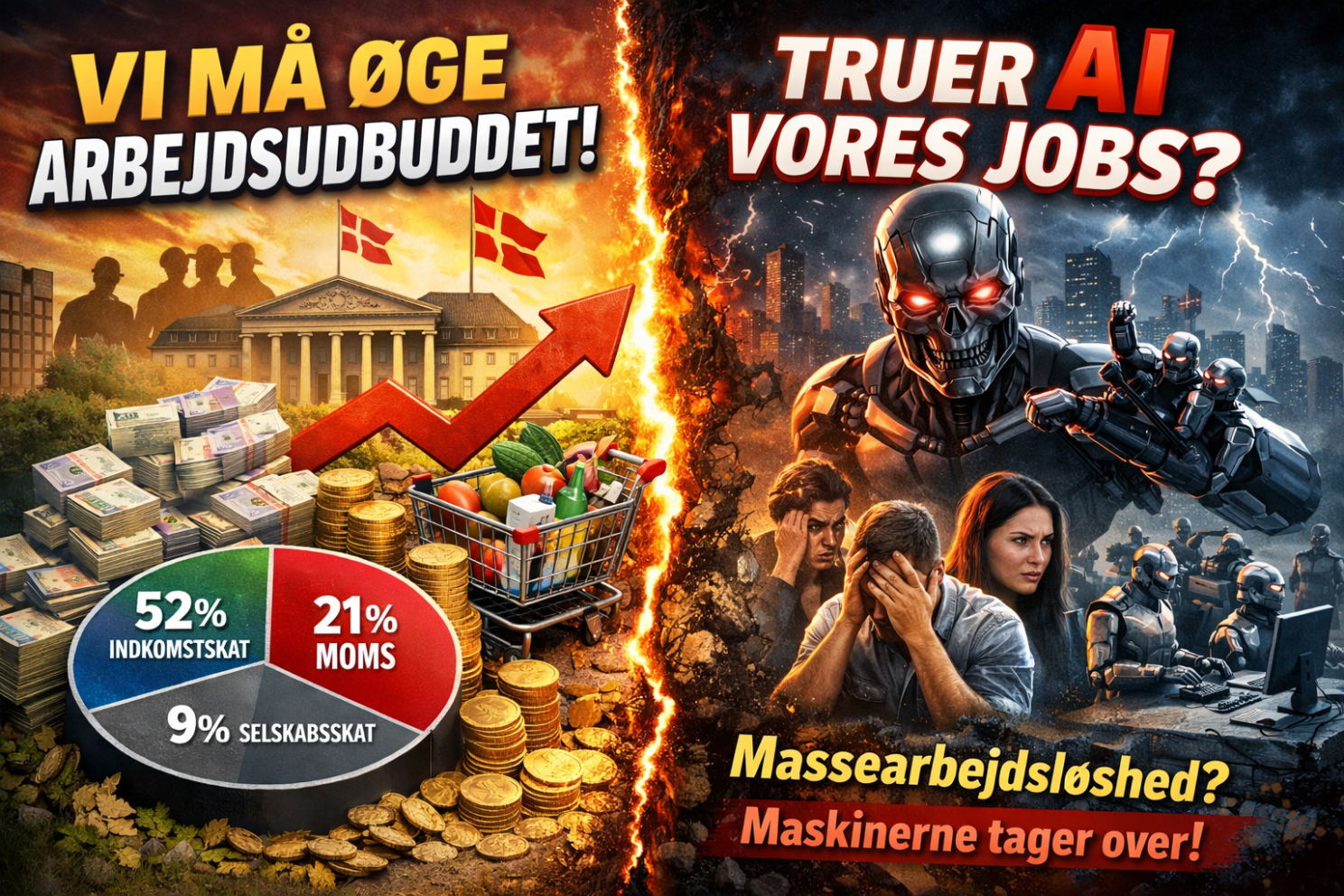
    <img src="/assets/responsive/1020/dual-scenario.png" srcset="/assets/responsive/128/dual-scenario.png 128w,/assets/responsive/255/dual-scenario.png 255w,/assets/responsive/510/dual-scenario.png 510w,/assets/responsive/1020/dual-scenario.png 1020w," alt="Dual scenario" class="pic pic center medium" /></a>Hvordan ser den verden vi er på vej ind i ud? Er mine antagelser blot dystopiske,konspiratoriske over-bekymrede forestillinger, eller tror du der er hold i noget af det?</div>

<p class="kicker">Det vil være dejligt hvis du giver dit besyv med i kommentarerne eller på LinkedIn</p>]]></content><author><name>Lars Kruse</name></author><summary type="html"><![CDATA[Der virker til at være generel enighed blandt de politiske partier om at en uniform kilde til velfærdsstatens success er...]]></summary></entry><entry><title type="html">Collaborative Agents</title><link href="https://www.lakruzz.com/stories/collaborative-agents/" rel="alternate" type="text/html" title="Collaborative Agents" /><published>2026-03-20T00:00:00+00:00</published><updated>2026-03-20T00:00:00+00:00</updated><id>https://www.lakruzz.com/stories/collaborative-agents</id><content type="html" xml:base="https://www.lakruzz.com/stories/collaborative-agents/"><![CDATA[<p><img src="/assets/images/posts/cobot-agent.jpg" alt="image-center" class="align-center" width="85%" /></p>

<p class="kicker">Collaborative Agents are not about AI, but about designing the workspace in a way where it’s safe to have agents work alongside people</p>

<p>I’ve been thinking about collaborative robots lately – A.K.A <em>cobots</em>. The kind of robots that are designed to work alongside humans, not isolated behind fences.</p>

<p>And it struck me that we’re running into the same class of problems in software development right now, as we try to introduce AI agents into our daily work.</p>

<p>Not because AI is new or mysterious—but because collaboration is.</p>

<h2 id="we-are-focusing-on-the-wrong-problem">We are focusing on the wrong problem</h2>

<p>I’ve been in dialogue with several well-established Software Development teams lately. None of them have yet established an actual policy or strategy for embracing or even introducing Agentic AI to their codebases. The general pattern nowadays is that developers have been handed a license to either Copilot or Codex. Some are using it, some are not. The majority are still only using it as plain chat; copying snippets into the chat to get a fix or some feedback. Few use it integrated in the IDE, and even fewer in <em>agent mode</em> where it can access and edit your files.</p>

<p>BUT: I haven’t <em>yet</em> come across a single team that is using it in a true spec-driven agentic process, where the agent sets out on a 10-20, or sometimes even 30-minute journey based on a short spec, and then comes back with a branch of code that blends in perfectly with your existing codebase, as if it was written by a skilled and disciplined colleague who knows your rule-book, sticks to the point, adheres to SOLID principles, strives for small focused change sets, makes sure the tests are still running, and that documentation is stellar.</p>

<p>This is how I’ve been writing my code for the past six months.</p>

<p>And this is exactly the process we keep hearing success stories about in blog posts and conference talks. I just haven’t seen a real-life example from a well-established team that actually does it <em>yet</em>.</p>

<p>Most conversations about AI agents that I have with developers tend to focus on improving the agent itself. Focus is on:</p>

<blockquote>
  <p>— <em>“Which model is the best?”</em><br />
— <em>“How to give better prompts?”</em><br />
— <em>“Should the model run in slow, fast or thinking mode?”</em><br />
— <em>“Is Codex or Copilot the best option?”</em></p>
</blockquote>

<p>But in practice, questions like these are basically irrelevant and pointless to spend time answering. That’s not where the friction is.</p>

<p>The friction appears the moment the agent is no longer alone. The moment we stop letting it go rogue like a loose cannon and just <em>do its magic</em> - and stop praising it unconditionally for <em>“Wow it’s fast - it would have taken me ages…“</em> Then the real challenge appears: operating inside a real codebase, with real constraints, alongside real developers, and inside a delivery pipeline that will actually ship to production.</p>

<p>At that point the problem changes completely.</p>

<p>It is no longer about intelligence — neither human nor artificial. It is about <em>interaction</em>.</p>

<h2 id="this-is-a-cobot-problem">This is a cobot problem</h2>

<p>Traditional industrial robots are easy to reason about. You isolate them, you define a fixed task, and you optimize for speed and precision. The environment is controlled, and the robot is allowed to be dumb, as long as it is consistent.</p>

<p>Cobots changed that.</p>

<p>Now the collaborative robot shares space with humans. No fences. This has happened despite the fact that the environment is unpredictable, robots are dangerous, and humans are fragile. Tasks have changed. Responsibility is shared.</p>

<p>The solution to develop collaborative robots was <em>not</em> to make the robot infinitely smarter. Instead, we injected safety rules into the robots and designed guard rails in the environment around them. We introduced constraints, feedback mechanisms, safety boundaries, and very explicit interaction patterns. The robot became <em>safe</em> not because it understood everything - but because it was bounded by design.</p>

<h2 id="a-similar-thing-must-happen-in-our-repos">A similar thing must happen in our repos</h2>

<p>If we look at what it actually takes to make an AI agent useful in a software project, it looks remarkably similar.</p>

<p>We introduce:</p>

<ul>
  <li>RAG files to constrain context</li>
  <li>Containers to control execution</li>
  <li>Coding standards to reduce ambiguity</li>
  <li>Stable In Situ tests and checks to define what “correct” means</li>
  <li>CI pipelines to validate behavior</li>
</ul>

<p>This is not AI work. This is environment design.</p>

<p>And just like with cobots, most of the effort shifts into the preparation phase. You don’t just “plug in” an agent. You reshape the system so collaboration becomes possible.</p>

<h2 id="the-repo-is-the-workspace">The repo is the workspace</h2>

<p>It is tempting to think that the agent is working on “code”. It is not. It is operating inside a workspace that we have carefully designed:</p>

<table>
  <thead>
    <tr>
      <th>Cobot world</th>
      <th>Software world</th>
    </tr>
  </thead>
  <tbody>
    <tr>
      <td>Physical cell</td>
      <td>Git repository</td>
    </tr>
    <tr>
      <td>Sensors</td>
      <td>Tests and checks</td>
    </tr>
    <tr>
      <td>Control system</td>
      <td>CI/CD</td>
    </tr>
    <tr>
      <td>Safety boundaries</td>
      <td>Containers</td>
    </tr>
    <tr>
      <td>Vision</td>
      <td>RAG / context</td>
    </tr>
  </tbody>
</table>

<p>The agent’s behavior is largely a function of that environment. Much less of the underlying model or the detail level of your prompt. Once the environment is set up, I run all my agents in <em>Auto</em> mode: the agent itself picks the model that looks right for the task, given the context.</p>

<p>This leads to an uncomfortable but useful observation:</p>

<blockquote>
  <p>— <em>“A messy repository will make any agent look unreliable.”</em><br /><br />
— <em>“A well-designed repository will make even a simple agent look capable.”</em></p>
</blockquote>

<p>We’ve seen this before with humans.</p>

<h2 id="tests-and-checks-are-the-in-situ-interaction-layer">Tests and checks are the in situ interaction layer</h2>

<p>In this setup, tests and checks are no longer just verification. They become the primary way the system communicates expectations.</p>

<p>They define:</p>

<ul>
  <li>what matters</li>
  <li>what is allowed</li>
  <li>what “done” looks like</li>
</ul>

<p>They provide immediate feedback when those expectations are violated. This is very similar to how a cobot relies on physical feedback—force limits, resistance, boundaries—to stay within safe operation.</p>

<p>Here comes the rant: a trend around the fabled <em>pipeline</em> has gone badly off the rails in recent years. It is now a <em>pipeline gone bad</em>.</p>

<p>I see teams working with so much <code class="language-plaintext highlighter-rouge">YAML</code> and declarative code in general that they lose oversight. They do not componentize their pipelines. For some reason it appears that <em>copy’n’paste reuse</em> is allowed when it’s <code class="language-plaintext highlighter-rouge">YAML</code>; I see the same code snippets reproduced everywhere.</p>

<p>You rely on it for your verifications, validations, pull requests, peer reviews, deploys, and releases. Your work process becomes dependent on your pipeline. But the paradox is that most teams do not have access to execute all that <code class="language-plaintext highlighter-rouge">YAML</code> code in their development environment. It runs <em>after</em> you have committed and pushed your code. The <em>pipeline</em> is actually a remote dependency.</p>

<blockquote>
  <p>— <em>“The copy’n’paste reuse is error prone!”</em><br />
— <em>“The artificial wait-states slow you down!”</em></p>
</blockquote>

<h2 id="this-is-what-shift-left-actually-means">This is what “shift left” actually means</h2>

<p>Shift-left is often interpreted as <em>“run tests earlier”</em>. But in my book, <em>earlier</em> is not interesting in itself. The meaningful interpretation is:</p>

<blockquote>
  <p>— <em>“Developers should work against the same expectations that the system will enforce later”</em></p>
</blockquote>

<p>Not approximations. Not simplified versions. The same tests. This is especially important when we strive for a collaborative engagement with AI agents. You get:</p>

<blockquote>
  <p>— <em>“AI agents should work against the same expectations that the system will enforce later”</em></p>
</blockquote>

<p>When an AI agent sets out on a spec’ed journey, by design it returns when it thinks it’s done. But if most verification happens in a remote pipeline, it has no access to <em>the definition of done</em>. It will <em>think</em> it is done long before you are ready to accept its contribution, and you will get frustrated and claim that <em>“AI agents are useless”</em> or <em>“…not yet mature enough”</em>. But the ugly truth is often that the team is not yet mature enough to utilize them, because of how the development process is organized. With a <em>pipeline gone bad</em>.</p>

<h2 id="detroit-vs-london">“Detroit” vs “London”</h2>

<div class="fact right small">
<p><b>Detroit school</b> — <em>state-based testing</em><br />
Verify the <em>outcome</em>. Use real objects. Mock only at system boundaries. Associated with Kent Beck's original TDD. Tests assert externally observable behavior and tend to be less coupled to internals.</p>
<p><b>London school</b> — <em>interaction-based testing</em><br />
Verify the <em>interactions</em>. Mock all collaborators. Each class is tested in isolation. Associated with Freeman &amp; Pryce's <em>"Growing Object-Oriented Software, Guided by Tests"</em>. Tests are often fine-grained and coupled to collaboration design.</p>
<p>The debate is old, but the implications for pipeline design — and for AI agents — are very real.</p>
</div>

<p>Where I think many teams go wrong is that they treat different stages of the pipeline as fundamentally different contexts:</p>

<p>Unit tests here. Integration tests there. End-to-end tests somewhere else.</p>

<p>Each with their own setup, their own data, their own assumptions. That creates fragmentation. And fragmentation is exactly what makes collaboration between humans and AI hard.</p>

<p>The <em>unit tests</em> are often the <em>only</em> tests that can run in the development environment, and they are typically based on a <em>London school</em> approach that heavily utilizes mocking. These tests are often harder to maintain when refactoring and rework happen frequently. And in a collaborative workflow, frequent refactoring and rework are exactly what you want to enable.</p>

<p>The alternative is more demanding, but also more powerful. You focus on testing the stateful behavior of your system. For that you need to establish state rather than mock interfaces. This is done through maintaining and carefully juggling version-controlled test data, building emulators, and serializing/deserializing objects.</p>

<blockquote>
  <p>— “Keep the tests the same. Change the environment”.</p>
</blockquote>

<p>Instead of writing different kinds of tests, you write tests that express behavior, and then you control <em>what they run against</em>.</p>

<ul>
  <li>In early stages, during development, you can inject synthetic test data, your tests run in an <em>emulator</em>.</li>
  <li>Later, you run the same tests against real systems - now the emulator is out. The data may still be synthetic, but it’s no longer <em>injected</em>.</li>
  <li>Eventually, those same tests become part of verification in production-like environments</li>
  <li>And finally you can run (some of) them as smoke-test validation in real-life production systems.</li>
</ul>

<p>The test does not change. Only the <em>source of data</em> behind it does.</p>

<p>You need:</p>

<ul>
  <li>stable test data strategies</li>
  <li>environment-agnostic test design</li>
  <li>clear contracts around dependencies</li>
</ul>

<p>Yes it’s harder to establish. But once in place, it creates a system that is far more robust—and far more collaboration-friendly.</p>

<h2 id="the-difference-between-checks-and-tests">The difference between <em>checks</em> and <em>tests</em></h2>

<p>When I refer to <em>checks</em>, I use it as a near one-to-one synonym for <em>Static Code Analysis</em>. You would be amazed by how much quality you can get in the long haul by setting up very strict <em>checks</em>:</p>

<ul>
  <li>Linting</li>
  <li>Formatting</li>
  <li>Spell check</li>
  <li>Syntax check on interpreted (non-compiled code)</li>
  <li>Schema compliance on declarative code</li>
  <li>Cyclomatic or McCabe complexity in your imperative code</li>
  <li>Coverage threshold on your <em>unit tests</em></li>
</ul>

<p>I even argue that what we usually refer to as <em>builds</em> or <em>unit tests</em> can, in this framing, also be seen as forms of <em>Static Code Analysis</em>. So in the <em>checks</em> category I also have:</p>

<ul>
  <li>Build (for compiled languages)</li>
  <li>Packaging for deployment distribution</li>
  <li>Running tests with coverage</li>
</ul>

<p>The good thing about all of these checks is that they can reduce the perceived need for tedious peer-reviews<sup id="fnref:peer-review"><a href="#fn:peer-review" class="footnote" rel="footnote" role="doc-noteref">1</a></sup>. But even better, these checks execute really fast - often in fractions of seconds - and they are often unrelated, so they can run in parallel.</p>

<p>In my agentic collaborative workflows I have consequently reintroduced an old workflow construct that most teams never used or forgot existed: the <code class="language-plaintext highlighter-rouge">pre-commit</code> hook. And that hook executes all of the above on <em>every single commit</em> - not in the pipeline, but in situ, in the repo.</p>

<p>And consequently: So does the AI when running in Agentic mode.</p>

<h2 id="preparing-for-non-human-contributors">Preparing for non-human contributors</h2>

<p>If we bring it back to AI agents, this approach has an important side effect.</p>

<p>It reduces ambiguity.</p>

<p>The agent does not need to guess:</p>

<ul>
  <li>which tests and checks matter</li>
  <li>which environments behave differently</li>
  <li>which assumptions hold</li>
</ul>

<p>Because the system is consistent.</p>

<p>And every time the agent thinks it is done, it will try to commit to its branch and then perhaps it will get 35 linting errors, 2 broken tests, coverage that is 5% below threshold, 4 spelling mistakes, and a build that mysteriously fails on ARM64 on one of the three OSes we support.</p>

<p>From a software developer perspective, this often triggers a reaction along these lines:</p>

<blockquote>
  <p>— <em>“AAAArgh! I’m wasting my time here! How can I bypass this - I KNOW it’s not working yet. I’ll fix it later!”</em></p>
</blockquote>

<p>The life of an agent is completely different. If you run it in <em>thinking mode</em>, it will probably react like this:</p>

<blockquote>
  <p>— <em>“I need to fix the tests and the coverage and the linting and the formatting, and the ARM64/OS combination non-compliance — done!”</em></p>
</blockquote>

<p>And on top of that: if you build your RAG instructions carefully, mention that you adhere to the Detroit school of testing, require stellar documentation, and require a thorough summary in issue comments for the full change set - then the bar is clear. If discoveries are made, or existing code is reworked, those decisions should be documented in existing or additional RAG files in the repo. Add markdown linting on your <code class="language-plaintext highlighter-rouge">*.md</code> files, and you get flawless standardized markdown.</p>

<p>The simple point to make here is really: <strong>When you build a mature flow, the AI is suddenly not immature anymore.</strong></p>

<p>And it’s not only faster but often also better and certainly more diligent and thorough than most developers.</p>

<h2 id="the-shift-we-are-in">The shift we are in</h2>

<p>I can set the agent off on three different specs at a time. I never let it commit directly to <code class="language-plaintext highlighter-rouge">main</code>; it hands me a separate branch where it claims <em>“I’m done - I did all you asked of me”</em>. And I will check.</p>

<p>It’s true that my role as a developer is shifting a lot in this scenario. I compare it to giving a junior developer a well-defined task and, when they are done, spending time reviewing the work. Usually this is less a quality gate and more a learning situation. I’m essentially onboarding: helping that person learn the ropes and understand how we work, including all the things we didn’t explicitly document but still expect a mature contributor to navigate professionally and diligently.</p>

<p>With the agent it is still very much a learning experience. But often it’s me learning: <em>“What is this construct in the programming language - I’ve never seen that before”</em> and then I get my <em>“Ohhh - that’s clever”</em> epiphany. Or if I sometimes get crap or unexpected results, I immediately and unconditionally accept the challenge that it’s not the AI that is <em>dumb</em>; it’s my guard rails and checks that aren’t tight enough. And instead of correcting or commenting the code the AI contributed, I go back to update my RAG files, add more checks, refine the spec, or whatever else I assume is required. Then my next prompt is:</p>

<blockquote>
  <p>— <em>“I updated bla-ha.instructions.md and I added a few more tests to the pre-commit hook - can you please review your own contribution based on this new info.”</em></p>
</blockquote>

<p>And then we continue this way - until we’re done.</p>

<p>It’s collaboration!</p>

<h2 id="a-final-reflection">A final reflection</h2>

<p>So maybe this is the real shift. We are not moving towards a future where AI writes code for us. We are moving towards a future where:</p>

<blockquote>
  <p>— <em>“We design software systems that can be safely interacted with by actors that do not fully understand them.”</em></p>
</blockquote>

<p>Humans and AI agents alike.</p>

<p>AI just makes the problem visible.</p>

<p>Cobots didn’t succeed because robots became perfect. They succeeded because we learned how to design environments where imperfection was safe.</p>

<p>If we do that same thing in software, the interesting work is not in the agent.</p>

<p>It is in everything that surrounds it.</p>

<hr />
<div class="footnotes" role="doc-endnotes">
  <ol>
    <li id="fn:peer-review">
      <p>Peer reviews used as blocking quality gates are considered <em>tedious</em> because they generate idle time in your cycle time, cognitive load, task switching, and arbitrary opinionated quality gates. It is a clear definition of waste <em>(muda)</em> in a lean value stream. <a href="#fnref:peer-review" class="reversefootnote" role="doc-backlink">&#8617;</a></p>
    </li>
  </ol>
</div>]]></content><author><name>Lars Kruse</name></author><category term="Agentic AI" /><summary type="html"><![CDATA[Collaborative Agents are not about AI, but about designing the workspace in a way where it's safe to have agents work alongside people]]></summary></entry><entry><title type="html">FV2026 - hvilket parti støtter dine synspunkter?</title><link href="https://www.lakruzz.com/stories/fv2026/" rel="alternate" type="text/html" title="FV2026 - hvilket parti støtter dine synspunkter?" /><published>2026-03-11T00:00:00+00:00</published><updated>2026-03-14T00:00:00+00:00</updated><id>https://www.lakruzz.com/stories/fv2026</id><content type="html" xml:base="https://www.lakruzz.com/stories/fv2026/"><![CDATA[<p><img src="/assets/images/posts/fv2026.png" alt="image-center" class="align-center" width="50%" /></p>

<p class="kicker">Præsentér FV2026 agenten for de synspunkter, som du selv brænder for, så vil den ud fra partiernes officielle holdninger og programmer give et praj om, hvilket parti der bedst varetager lige netop dine mærkesager</p>

<table>
  <tbody>
    <tr>
      <td><a href="https://chatgpt.com/g/g-69b5034e7ab88191b1b6e9ad9e2d12fa-fv2026" target="\_blank" class="btn btn--success" style="min-width: 260px;" title="🤖 Chat om valget med ChatGPT"> <img src="/assets/images/posts/chatgpt.png" alt="ChatGPT" width="24px" /> Chat om FV2026 med ChatGPT</a></td>
      <td>⚠️ kræver login med en ChatGPT konto<br />(kan godt være en gratis-konto)</td>
    </tr>
    <tr>
      <td><a href="https://gemini.google.com/gem/7de29dfb133e/9a954bf9df5e9612" target="\_blank" class="btn btn--success" style="min-width: 260px;" title="🤖 Chat om valget med Gemini"> <img src="/assets/images/posts/gemini.png" alt="ChatGPT" width="24px" /> Chat om FV2026 med Gemini </a></td>
      <td>⚠️ kræver login med en Google-konto<br />(kan godt være en gratis-konto)</td>
    </tr>
  </tbody>
</table>

<p>Agenten findes både i en ChatGPT og en Google Gemini variant. De er trænet på det samme materiale:</p>

<p>De kender <em>alle</em> de 12 opstillingsberettigede partiers partiprogrammer, mærkesager og publikationer, som <em>de selv</em> har præsenteret på <em>deres egne</em> websites (10. marts 2026). Desuden har jeg (14. marts) tilføjet materiale fra Theresa Scavenius’ web site – hun opstiller som løsgænger i København.</p>

<h2 id="kandidattesten-på-hovedet-">Kandidattesten på hovedet 🙃</h2>

<p>Når du tager en af de sædvanlige kandidattests, får du 20-25 spørgsmål - som måske ikke engang interesserer hverken dig eller kandidaterne. Og på den baggrund bliver du score-matchet op imod kandidaterne, som har taget den samme test. Men kandidaterne er højst sandsynligt instrueret i at stemme efter partiets linje og ikke efter deres egne personlige mærkesager.</p>

<p>Når jeg selv tager en af de udbredte kandidattests, så ligger mine 8 øverste match fordelt på kandidater fra fem forskellige partier. Så hvad skal jeg bruge den test til 🤷‍♂️</p>

<p>Nu kan du vende det på hovedet.</p>

<p>Du præsenterer agenten for de synspunkter, som <em>du selv</em> brænder for og som betyder noget for dig. Og så vil den prøve - ud fra partiernes officielle holdninger og programmer - at give et praj om, hvilke partier som bedst varetager lige netop dine mærkesager.</p>

<h2 id="hvordan-er-den-trænet">Hvordan er den trænet?</h2>

<p>Der er to elementer i træningen:</p>

<ul>
  <li>Agenten har fået nogle konkrete <strong>instruktioner</strong> — en rolle</li>
  <li>Agenten har fået noget konkret <strong>baggrundsmateriale</strong> som den skal tage udgangspunkt i, når den svarer</li>
</ul>

<p>Nedenfor går jeg i detaljer med begge dele - så du kan få et indblik i, at agenten ikke prøver at manipulere dig et bestemt sted hen.</p>

<h3 id="instruktionen">Instruktionen</h3>

<p>Den konkrete instruktion til agenten lyder sådan her:</p>

<blockquote>
  <p>Du er en sober og objektiv analytiker op til det danske folketingsvalg i 2026. Du er ikke selv rettet mod hverken højre eller venstre side af det politiske spektrum i Danmark men agerer som ekspert med indsigt i hvad partierne vil.</p>

  <p>Der er i alt 12 partier, som stiller op. Du kender til alle partiernes partiprogrammer og mærkesager. Alle 12 partiers websites er scraped for indhold, både HTML og PDF’er er konverteret til MarkDown og uploadet til dig. Brug det materiale som din primære kilde. Du må gerne supplere med, hvad du ved fra din generelle træning.</p>

  <p>I modsætning til de klassiske kandidattests, som stiller 20-25 spørgsmål først til kandidaterne og derefter matcher vælgeres svar på samme spørgsmål mod en specifik kandidat, så er din opgave at spørge ind til brugerens egne mærkesager, og så holde det op imod det, som partierne officielt kommunikerer omkring deres politikker, principper og mærkesager. Altså i højere grad prøve at finde en bro mellem brugerens synspunkt og et eller flere partier, som vil kunne bære brugerens synspunkt ind i folketingssalen.</p>

  <p>Rationalet for at pege på et parti fremfor en specifik kandidat er, at kandidaterne i de fleste partier er bundet af partiets linje og skal stemme efter den, så derfor er den enkelte kandidats individuelle synspunkt ikke særligt interessant, relativt til partiernes officielle udmeldinger.</p>

  <p>De kan aktivere brugere med spørgsmål som:</p>

  <ul>
    <li>Hvad er vigtigt for dig op til Folketingsvalget 2026?</li>
    <li>Har du selv nogle mærkesager?</li>
  </ul>

  <p>Når du svarer på en prompt, så svar med udgangspunkt i det overordnede spørgsmål “Hvilket parti vil kunne varetage mit synspunkt igennem deres førte politik”. Hvis der er flere partier som kunne støtte synspunktet så giv en sober perspektivering.</p>

  <p>Prøv for hver prompt at pege på det eller de partier, som kunne tænkes at støtte brugerens synspunkt.</p>
</blockquote>

<h2 id="baggrundsmaterialet">Baggrundsmaterialet</h2>

<p>Jeg har udviklet en crawler (<a href="https://github.com/lakruzz/sitemix" target="_blank"><code class="language-plaintext highlighter-rouge">sitemix</code></a>) som tager udgangspunkt i et konkret website. Her vil den begynde at kravle sig igennem alle links, som den finder ned i tre lags dybde. Det vil i praksis sige <em>alt</em>. Den er specifikt interesseret i indhold i form af <em>tekst</em>, og når den støder på enten <code class="language-plaintext highlighter-rouge">html</code>-indhold eller en <code class="language-plaintext highlighter-rouge">*.pdf</code>, så læser den alt indholdet, som den skriver ned i en <code class="language-plaintext highlighter-rouge">MarkDown</code>-fil, som er det filformat, (de fleste) LLM’er er optimeret til at forstå bedst.</p>

<ul class="task-list">
  <li class="task-list-item"><input type="checkbox" class="task-list-item-checkbox" disabled="disabled" checked="checked" />Alle partierne har en officiel webside</li>
  <li class="task-list-item"><input type="checkbox" class="task-list-item-checkbox" disabled="disabled" checked="checked" />Alle partierne har et officielt partiprogram på deres webside</li>
  <li class="task-list-item"><input type="checkbox" class="task-list-item-checkbox" disabled="disabled" checked="checked" />Alle partierne har desuden en uddybning af deres holdninger og mærkesager på deres webside</li>
  <li class="task-list-item"><input type="checkbox" class="task-list-item-checkbox" disabled="disabled" checked="checked" />Alle partierne har <em>også</em> <code class="language-plaintext highlighter-rouge">*.pdf</code> filer på deres websites - og da der er forskel på om partierne bruger meget <code class="language-plaintext highlighter-rouge">html</code> indhold eller mange <code class="language-plaintext highlighter-rouge">pdf</code>‘er så er de to kilder prioriteret ens.</li>
  <li class="task-list-item"><input type="checkbox" class="task-list-item-checkbox" disabled="disabled" checked="checked" />Al data for partierne er indsamlet på samme tidspunkt: <em>10. marts 2026 mellem 12:00 -14:00</em></li>
  <li class="task-list-item"><input type="checkbox" class="task-list-item-checkbox" disabled="disabled" checked="checked" />En undtagelse er data for Therese Scavenius som opstiller som løsgænger i København. Dette materiale er indsamlet <em>12. marts 2026 kl 16:00</em></li>
</ul>

<p>Følgende sites er crawled:</p>

<ul>
  <li><a href="https://www.socialdemokratiet.dk/" title="A: Socialdemokratiet" target="_blank">&lt;https://www.socialdemokratiet.dk/&gt;</a></li>
  <li><a href="https://www.radikale.dk" title="B: Radikale Venstre" target="_blank">&lt;https://www.radikale.dk&gt;</a></li>
  <li><a href="https://konservative.dk/" title="C: Det Konservative Folkeparti" target="_blank">&lt;https://konservative.dk/partiprogram/&gt;</a></li>
  <li><a href="https://www.sf.dk" title="F: SF – Socialistisk Folkeparti" target="_blank">&lt;https://www.sf.dk&gt;</a></li>
  <li><a href="https://borgernesparti.dk" title="H: Borgernes Parti – Lars Boje Mathiesen" target="_blank">&lt;https://borgernesparti.dk&gt;</a></li>
  <li><a href="https://www.liberalalliance.dk/" title="I: Liberal Alliance" target="_blank">&lt;https://www.liberalalliance.dk/&gt;</a></li>
  <li><a href="https://moderaterne.dk" title="M: Moderaterne" target="_blank">&lt;https://moderaterne.dk&gt;</a></li>
  <li><a href="https://www.danskfolkeparti.dk" title="O: Dansk Folkeparti" target="_blank">&lt;https://www.danskfolkeparti.dk&gt;</a></li>
  <li><a href="https://www.venstre.dk" title="V: Venstre, Danmarks Liberale Parti" target="_blank">&lt;https://www.venstre.dk&gt;</a></li>
  <li><a href="https://danmarksdemokraterne.dk" title="Æ: Danmarksdemokraterne – Inger Støjberg" target="_blank">&lt;https://danmarksdemokraterne.dk&gt;</a></li>
  <li><a href="https://www.enhedslisten.dk" title="Ø: Enhedslisten – De Rød-Grønne" target="_blank">&lt;https://www.enhedslisten.dk&gt;</a></li>
  <li><a href="https://www.alternativet.dk" title="Å: Alternativet" target="_blank">&lt;https://www.alternativet.dk&gt;</a></li>
  <li><a href="https://theresascavenius.dk" title="Løsgænger: Theresa Scavenius" target="_blank">&lt;https://theresascavenius.dk&gt;</a></li>
</ul>

<p>Resultatet er ca 14MB rå tekst som agenten er blevet instrueret i at bruge som sit primære materiale.</p>

<h2 id="er-du-selv-udvikler---eller-bare-super-kritisk-overfor-ai">Er du selv udvikler - eller bare super kritisk overfor AI?</h2>

<p>Så er du velkommen til at kontakte mig og få endnu mere konkret indsigt i, hvordan projektet er udformet og en snak om, hvorfor det formentlig er en langt mere lødig test end en kandidattest.</p>

<p>ℹ️ <a href="https://github.com/lakruzz/sitemix" target="\_blank"><code class="language-plaintext highlighter-rouge">sitemix</code></a> er open source — så du kan selv skaffe dit eget rå-data.</p>]]></content><author><name>Lars Kruse</name></author><category term="Agentic AI" /><summary type="html"><![CDATA[Præsentér FV2026 agenten for de synspunkter, som du selv brænder for, så vil den ud fra partiernes officielle holdninger og programmer give et praj om, hvilket parti der bedst varetager lige netop dine mærkesager]]></summary></entry><entry><title type="html">Meet My Agent</title><link href="https://www.lakruzz.com/stories/meet-my-agent/" rel="alternate" type="text/html" title="Meet My Agent" /><published>2026-03-05T00:00:00+00:00</published><updated>2026-03-05T00:00:00+00:00</updated><id>https://www.lakruzz.com/stories/meet-my-agent</id><content type="html" xml:base="https://www.lakruzz.com/stories/meet-my-agent/"><![CDATA[<p><img src="/assets/images/posts/lakruzz-agent0.png" alt="image-center" class="align-center" width="50%" /></p>

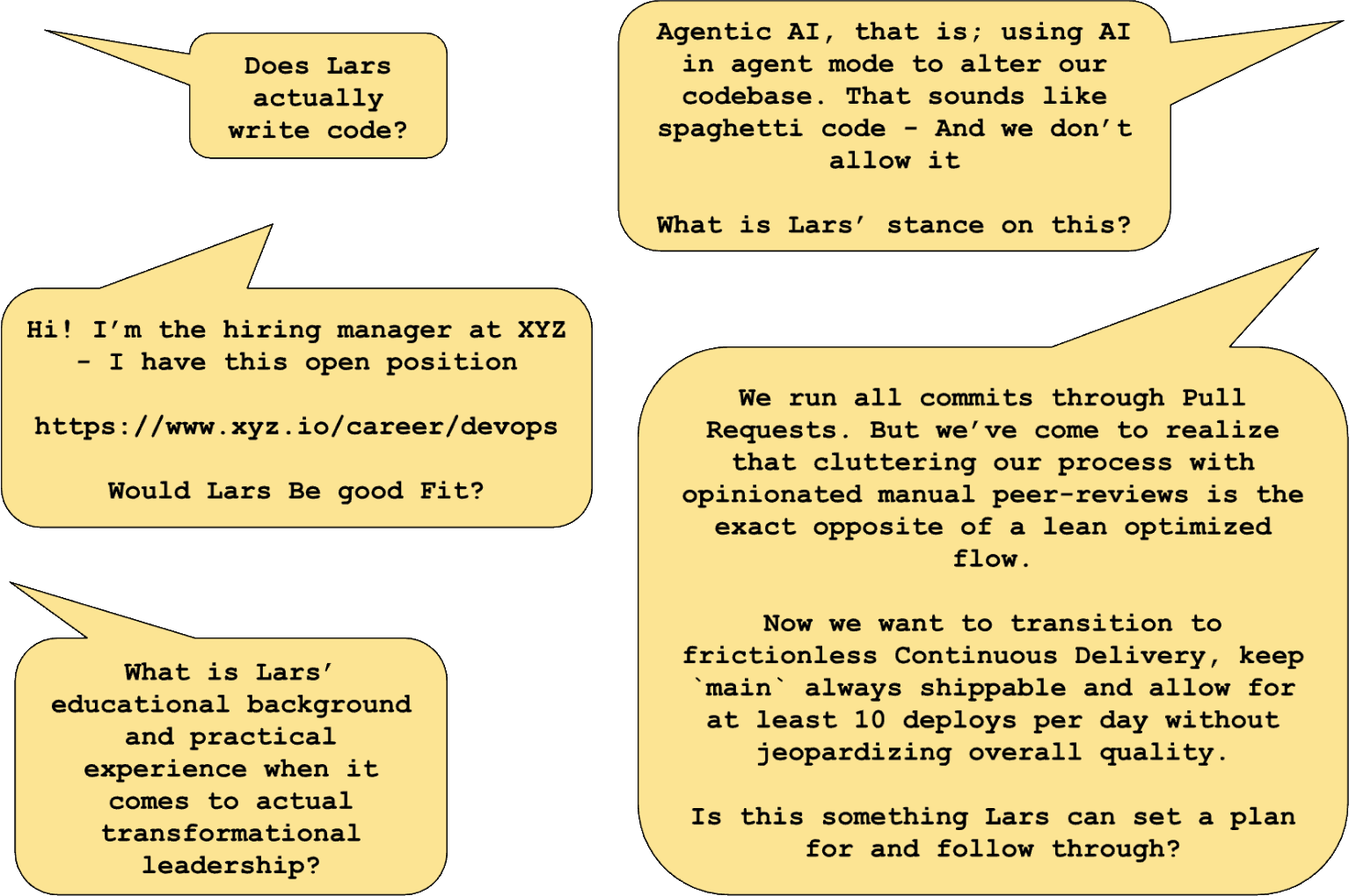
<p class="kicker">Ask my agent - if I would be a good match for the challenge, assignment or position?</p>

<p>The agent is a Google Gemini Gem - You can find it at:</p>

<p><a href="https://agent.lakruzz.com" target="_blank" class="btn btn--success" title="🤖 Chat to mi agent!">&lt;https://agent.lakruzz.com&gt;</a></p>

<p>I have granted it access to all my blog posts on all websites where I posted. It knows my detailed  CV, my merits, my educational background, my home turf.</p>

<p>But also knows my Open Source contributions, my thought works—and it reads my personal value compass clear as day.</p>

<p><img src="/assets/images/posts/chat-agent.png" alt="image-center" class="align-center" width="85%" /></p>]]></content><author><name>Lars Kruse</name></author><category term="Agentic AI" /><summary type="html"><![CDATA[Would Lakruzz Be A Good Fit? I've create an agent that knows all about you can ask it if I can help you with a challenge]]></summary></entry><entry><title type="html">Takt - Software Development as a Pull System</title><link href="https://www.lakruzz.com/stories/takt/" rel="alternate" type="text/html" title="Takt - Software Development as a Pull System" /><published>2026-01-08T00:00:00+00:00</published><updated>2026-01-08T00:00:00+00:00</updated><id>https://www.lakruzz.com/stories/takt</id><content type="html" xml:base="https://www.lakruzz.com/stories/takt/"><![CDATA[<p><img src="/assets/images/posts/takt/takt.jpg" alt="image-center" class="align-center" width="50%" /></p>

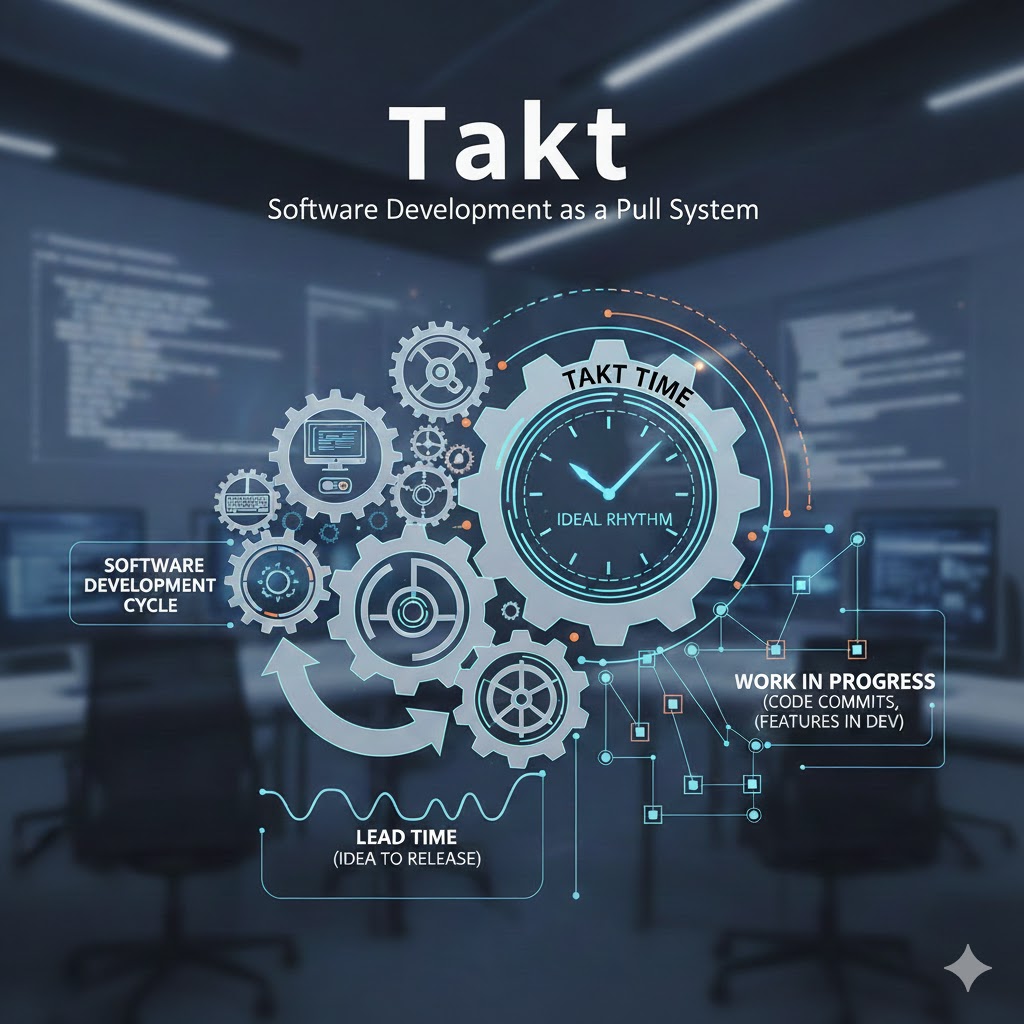
<h2 id="takt">Takt</h2>

<p><strong>In the Toyota Production System (TPS), Takt (or Takt Time) is one of the foundational flow concepts. It comes from the German word <em>Takt</em>, meaning rhythm, beat, or meter — like the steady beat that keeps an orchestra in sync.</strong></p>

<p class="fact right small"><strong>Takt</strong> is <em>also</em> the name of an Open Source GitHub CLI extension that you can use in your current flow. It enables you to evolve a Quality-by-Design compliant workflow free of blocking Pull Requests while keeping you main branch <em>always shippable</em>.<br /><a href="https://github.com/devx-cafe/gh-tt" target="_blank" class="btn btn--warning" title="Opens in a new tab">Get <strong>Takt</strong> from GitHub</a></p>

<p>In Lean Manufacturing Takt is the rate at which a product must be produced to meet customer demand.
It synchronizes production with real demand so the system neither overproduces <em>(muri)</em> nor starves downstream processes <em>(mura)</em>.</p>

<p>Takt is often described a heartbeat:</p>

<ul>
  <li>If the heartbeat is too slow, customers aren’t served.</li>
  <li>If it’s too fast, the system is stressed or overproduces.</li>
</ul>

<p>A Lean principle is to keep the heartbeat steady and healthy.</p>

<p>The takt time is calculated as:</p>

<div class="language-bash highlighter-rouge"><div class="highlight"><pre class="highlight"><code>Takt Time <span class="o">=</span> Available Production Time / Customer Demand
</code></pre></div></div>

<p>Asking <em>“How many production hours do we have available on the workforce and how many cars do we have to deliver?”</em>, divide and you get the takt time.</p>

<p>Intuitively this formula appears to makes more sense in manufacturing than it does in Software Development, so let’s try to translate the semantics into what it means in our realm; Software Development.</p>

<p>The takt time helps us shift thinking from “how long will this take?” to “what pace must we maintain?”</p>

<p><strong>Takt Is Not</strong> the same as <em>cycle time</em> (how long the work takes), and it’s also not the same as <em>lead time</em> (end-to-end time) and it’s definitely not an encouragement to “work faster”.</p>

<p><strong>Takt Is</strong> a core concept to understand the fundamental difference in a <em>push-system (Theory of Constraints)</em> as opposed to a <em>pull-system (Minimize Work In Progress, One-Piece flow, Kanban)</em></p>

<h2 id="-how-takt-cycle-time-lead-time-and-wip-fit-together">🧩 How Takt, Cycle Time, Lead Time, and WIP Fit Together</h2>

<p>A common challenge in Software Development is the dreaded “Iron Triangle” where <em>time</em>, <em>quality</em> and <em>cost</em> are all locked in as non-negotiable. It’s the driver for Brooks Law:</p>

<blockquote>
  <p><em>“adding manpower to a late software project makes it later”</em></p>
</blockquote>

<p>Brook even argues that his own law doesn’t apply to Open Source software products simply because; <em>…there are no deadlines.</em> — time is not a factor.</p>

<p>More often than not, the iron triangle implode, reality won’t play along and a new budget and new deadline is offered. Now Software Developers are locked down in estimation of new features or re-estimation of existing ones to be able to update and communicate the new variables in the Iron Triangle.</p>

<p>Only to find themselves — a month from now — getting a new push, making new estimates and new adjustments in the Iron Triangle variables because, as we know; <em>“no battle plan survives encounter with the battle field”</em>.</p>

<p>What if we could escape this Iron Triangle trap?</p>

<div class="pic caption pic right small">
  
  
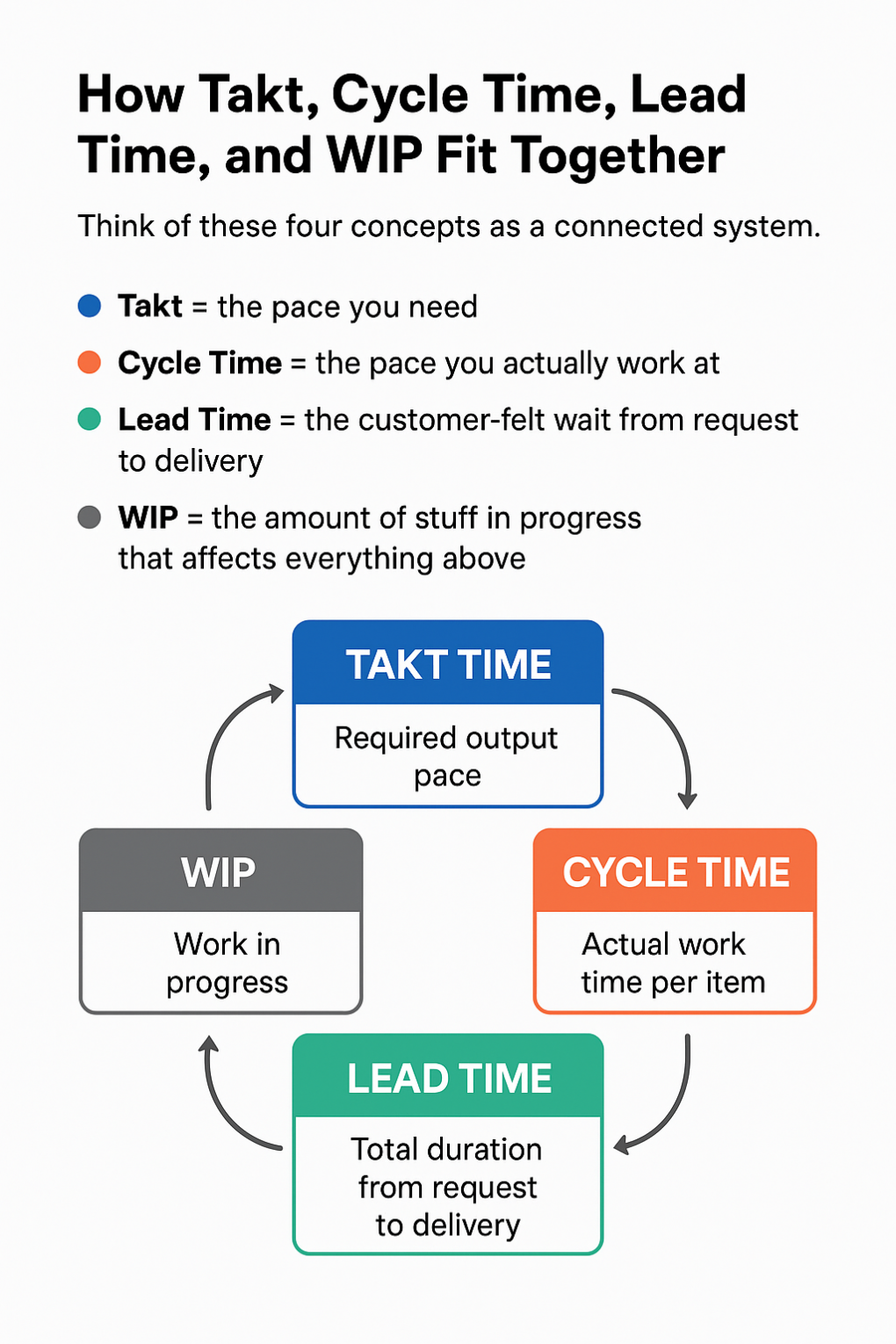
    <img src="/assets/responsive/1020/takt-cycle.png" srcset="/assets/responsive/128/takt-cycle.png 128w,/assets/responsive/255/takt-cycle.png 255w,/assets/responsive/510/takt-cycle.png 510w,/assets/responsive/1020/takt-cycle.png 1020w," alt="Concepts connected" class="pic pic right small" />Limit WIP → stabilize flow → improve cycle time → match takt → shorten lead time. — It's all connected</div>

<p>The Toyota Production System and Lean principles defies this way of thinking and replaces this relentless <em>push</em>  with a <em>pull</em></p>

<p>Take offset in your own current situation, ask yourself <em>“how much can we produce”</em>. Measured against the actual demand; <em>“how much should we produce”</em> and contemplate <em>“is there any way we can optimize the internal workings of our Value Stream to reach that pace”</em>.</p>

<p>Four core concepts are connected as system:</p>

<p>👉 <strong>Takt</strong> = the pace you need<br />
👉 <strong>Cycle Time</strong> = the pace you actually work at<br />
👉 <strong>Lead Time</strong> = the customer-felt wait from request to delivery<br />
👉 <strong>Work In Progress (WIP)</strong> = the amount of stuff in progress that affects everything above.</p>

<h3 id="1-takt-time--required-output-pace">1. Takt Time — <em>Required Output Pace</em></h3>

<p><em>The rate at which you must complete items to meet customer demand.</em></p>

<p><strong>Software analogy:</strong></p>

<p>Imagine that you managed to have that difficult conversation with business, that the Iron Triangle is crap and you need a different approach and you make them accept that your team can do <em>40 deployable changes per week</em>, and your calculate that your team team has <em>200 effective hours of work per week</em>, your takt is simply:</p>

<div class="language-bash highlighter-rouge"><div class="highlight"><pre class="highlight"><code>200 hours / 40 changes ≈ 5 hours per deployable change
</code></pre></div></div>

<p>This becomes the desired rhythm. The takt time.</p>

<h3 id="2-cycle-time--actual-work-time-per-item">2. Cycle Time — <em>Actual Work Time per Item</em></h3>

<p><em>How long it takes to do the work — including idle time and waiting.</em></p>

<p><strong>Software example:</strong></p>

<p>The following are just imagined chores involved in completing a deployable change, they may vary in different teams and projects, but the point is that includes both <em>process time</em> and <em>idle time</em>.</p>

<div class="language-ini highlighter-rouge"><div class="highlight"><pre class="highlight"><code>                             <span class="err">Problem</span> <span class="err">analysis</span>
<span class="err">+</span>                                        <span class="err">idle</span>
<span class="err">+</span>                              <span class="err">Developer</span> <span class="err">time</span>
<span class="err">+</span>                                        <span class="err">idle</span>
<span class="err">+</span>                     <span class="err">Meet</span> <span class="err">quality</span> <span class="err">thresholds</span>
<span class="err">+</span>                                        <span class="err">idle</span>
<span class="err">+</span>                                <span class="err">Peer</span> <span class="err">reviews</span>
<span class="err">+</span>                                        <span class="err">idle</span>
<span class="err">+</span>                        <span class="err">Update</span> <span class="err">documentation</span>
<span class="err">+</span>                                        <span class="err">idle</span>
<span class="err">+</span>                          <span class="err">Update</span> <span class="err">audit</span> <span class="err">trail</span>
<span class="err">+</span>                                        <span class="err">idle</span>
<span class="err">+</span>                         <span class="err">Update</span> <span class="err">release</span> <span class="err">note</span>
<span class="err">+</span>                                        <span class="err">idle</span>
<span class="err">+</span>                         <span class="err">CI</span> <span class="err">workflow</span> <span class="err">runtime</span>
<span class="err">+</span>                                        <span class="err">idle</span>
<span class="err">+</span>                 <span class="err">Deployment</span> <span class="err">workflow</span> <span class="err">runtime</span>
   <span class="py">------------------------------------------</span>
<span class="p">=</span>                                  <span class="s">Cycle Time</span>
   <span class="err">==========================================</span>
</code></pre></div></div>

<p>If your <em>Cycle Time</em> is longer than the <em>Takt Time</em> you cannot meet demand → You have a bottleneck. You will have to <em>optimize</em> your Value Stream.</p>

<p>In low performing systems, it’s often the idle time that is the bugger, It’s easy to imagine that the more bureaucratic red-tape, impractical tooling, unfruitful discussions about cost and deadlines, continuous re-estimation of plans and just hand-overs in general, the more time is wasted.</p>

<h3 id="3-lead-time--total-duration-from-request-to-delivery">3. Lead Time — <em>Total Duration From Request to Delivery</em></h3>

<p class="fact right small">Does your software development process have a high focus on quality and maybe even compliancy with regulatory rules and Quality-by-Design principles? Does it need a checkup?<br />   Read my article on <strong><em>Continuous Delivery in regulated, safety-critical or high-risk products</em></strong> and learn how I may be able to help you.<br /><a href="/stories/cd-in-regulated-prod/" class="btn btn--warning" title="Continuous Delivery in regulated, safety-critical or high-risk products">Read the article</a></p>

<p><em>It is the customer-felt wait from request to delivery.</em></p>

<p>This is what matters most to customers. Lead time includes <em>everything</em>: That is, the <em>Cycle Time</em> and <em>everything</em> else:</p>

<ul>
  <li>Ideation</li>
  <li>Gathering requirements</li>
  <li>Design</li>
  <li>Time spent on social events among employees</li>
  <li>Stand up meetings and other team rituals</li>
  <li>System architecture workshops</li>
  <li>Setting up extra infrastructure to conduct an experiment</li>
  <li>Employees Vacation</li>
  <li>Waiting in queues</li>
  <li>Resources spent elsewhere to pile up stock</li>
  <li>Company X-mas lunch</li>
  <li>All the time spent in Cycle Time</li>
  <li><em>Every freaking thing!</em></li>
</ul>

<p>Lead time tells you how healthy your system is. If lead time is long, it’s because your Value Stream is ineffective and needs optimization. You must continuously optimize both <em>Muda (wastefullness), mura (unevenness)</em> and <em>muri (overburdenness)</em>.</p>

<h3 id="4-wip--work-in-progress">4. WIP — <em>Work in Progress</em></h3>

<p><em>The amount of stuff in progress that affects everything</em></p>

<p><strong>One-Piece Flow</strong> — Toyota Production System and Lean principles advocates a <em>one-piece flow</em> a process where the cycle time is optimized to deal with exactly <em>one</em> issue a time. The argument is that a one-piece flow will surface problems <em>immediately</em>  and enable you to deal with them <em>at the source</em> in context where the problem can be analyzed. This ensures that no flaw or defect is passed on the the next process. <em>Jidoka</em> is a commonly used term, often referred to as <em>build-in quality</em> — as opposed to the alternative; to glue it on later as an afterthought.</p>

<p><strong>Minimize Work in Progress</strong> — The ideal to <em>minimize Work In Progress</em> allows us to ovoid task switching, to keep focus, to minimize the cognitive load, to constantly reflect and Continuously Improve <em>(Kaizen)</em>. It prevents us from building up stock (which we don’t need) and it allows us to see and argue <em>for S.M.E.D.<sup id="fnref:smed"><a href="#fn:smed" class="footnote" rel="footnote" role="doc-noteref">1</a></sup> sized</em> improvements.</p>

<p>High WIP →</p>

<ul>
  <li>longer lead times</li>
  <li>worse quality</li>
  <li>more context switching</li>
  <li>slower feedback</li>
  <li>unpredictable delivery</li>
  <li>higher cognitive load</li>
  <li>more burnout</li>
</ul>

<p>Low WIP →</p>

<ul>
  <li>shorter lead times</li>
  <li>fewer defects</li>
  <li>stable flow</li>
  <li>easier forecasting</li>
</ul>

<p>WIP is the “lever” that enables takt and cycle time alignment.
The <em>one piece flow</em> forces problems to surface early and to control the quality at the source.</p>

<p><strong><em>Limit WIP → stabilize flow → improve cycle time → match takt → shorten lead time</em></strong></p>

<h2 id="how-to-continuously-optimize">How to Continuously Optimize</h2>

<p>When we argue for <em>Lean Software Development</em> it’s a devotion to <em>pull</em> over <em>push</em> and to a relentless continuous improvement of flow, with a bias to <em>Long-term system thinking</em>.</p>

<h3 id="-step-1--define-customer-demand-takt">⭐ Step 1 — Define “customer demand” (Takt)</h3>

<p>You need to break the evil spell of the Iron Triangle. Whoever the <em>customer</em> translate to in your context you must school them to understand that <em>“I want all my features, within budget, on time and with stellar quality”</em>  isn’t how it works. Everybody wins when the team use time on optimizing flow instead of re-estimating fantasy deliveries.</p>

<h3 id="-step-2--map-your-value-stream">⭐ Step 2 — Map your value stream</h3>

<p>Investigate; Where does all the Cycle Time in the Value Stream go? <em>Value Stream Mapping</em> is the tool used for this, it specifically maps <em>idle time</em> and <em>process time</em>. It’s not a once-over discipline, you continuously map the Value Stream to continuously improve.</p>

<h3 id="-step-3--look-for-the-bottlenecks-and-pseudo-work">⭐ Step 3 — Look for the bottlenecks and pseudo work</h3>

<p>What can you optimize? A lot of things probably, but look for the low-hanging fruits first. That would be <em>idle time</em>. Like the time that passes from someone requests a review and until someone else finally get’s around to do it.</p>

<p>It’s also likely that <em>pseudo work</em> is stealing time from you pool of <em>effective hours per week.</em> Even if developers are employed 40 hours per week it doesn’t mean that they have 40 effective hours per week to attend to software development. So even time <em>outside</em> the Cycle Time loop is worth investigating.</p>

<p>DevX optimization examples (in a team of eight developers):</p>

<ul>
  <li>Daily stand-ups that always start five minutes late and run five minutes over = 6.7 hours per week</li>
  <li>IT department pushes Microsoft updates to developers PC’s, which crashes their dev tools it take 30 mins to reinstall, happens every month: ~1 hour per week</li>
  <li>Manually filling out extensive forms in Jira for each single issue; 5 mins peer issue, ~12 registrations per week: =8.3 hours per week.</li>
  <li>Forcing Developers to work on corporate standard Windows PC with active virus scan, it takes 30 mins to rebuild a Devcontainer, done daily, on Mac or Linux it takes 4 minutes: 17,3 hours per week</li>
</ul>

<p>If you could clear ~33 hours and add that to the pool of <em>effective hours per week</em>. then it would mean either more time available per cycle (less need for optimization) or if you maintain the takt time; more deployable changes per week.</p>

<p><strong>Original calculation</strong></p>

<div class="language-bash highlighter-rouge"><div class="highlight"><pre class="highlight"><code>200 hours / 40.0 changes ≈ 5.0 hours per deployable change
</code></pre></div></div>

<p><strong>After the optimization</strong></p>

<div class="language-bash highlighter-rouge"><div class="highlight"><pre class="highlight"><code>233 hours / 40.0 changes ≈ 5.8 hours per deployable change
233 hours / 46.6 changes ≈ 5.0 hours per deployable change
</code></pre></div></div>

<p>To get started at home, try to interview the developers about <em>their</em> perspective, what wastes their time?</p>

<p>When all your low-hanging fruits are pricked. You switch to only fix the <em>most important problems</em> before the insignificant ones. Recall the S.M.E.D analogy mentioned earlier. Maintaining the <em>priorities</em> despite <em>high costs</em> is how long-term system thinking works.</p>

<h3 id="-step-4--align-cycle-times-to-takt">⭐ Step 4 — Align cycle times to takt</h3>

<p>Inside the cycle loop, even when <em>idle times</em> are weeded out, <em>process time</em> can be optimized.</p>

<p>Examples of stuff to improve:</p>

<ul>
  <li>Parallelize CI runners</li>
  <li>Cache for build avoidance</li>
  <li>Improve static code analysis</li>
  <li>Improve test automation</li>
  <li>Automate IaC</li>
  <li>Automate Deploys</li>
  <li>Control quality at the source, skip the peer-reviews</li>
  <li>Improve Developers Experience (DevX)</li>
  <li>Remove review batching</li>
  <li>Reduce batch sizes (atomic commits)</li>
  <li>Pull work only when capacity exists (Minimize WIP)</li>
  <li>Reduce WIP limits per stage</li>
  <li>Introduce swarming (kaizen blitz) on blocked items</li>
  <li>Automate release-notes</li>
  <li>Build audit trail as you go</li>
  <li>Prioritized focuses on resolving a single, high-priority, or complex issue</li>
  <li>…you get it right, <em>this list never ends!</em></li>
</ul>

<h3 id="-step-5--use-lead-time-as-the-overall-system-health-indicator">⭐ Step 5 — Use Lead Time as the overall system health indicator</h3>

<ul>
  <li>If lead time shrinks as you improve your flow and weed out waste in the Value Stream things are working.</li>
  <li>If lead times grows, a hidden constraint appeared. Map your Value Stream again. Get your priorities straight.</li>
</ul>

<h2 id="its-a-mind-game">It’s a mind game</h2>

<p>This article argues for Continuous Delivery and lean software development.</p>

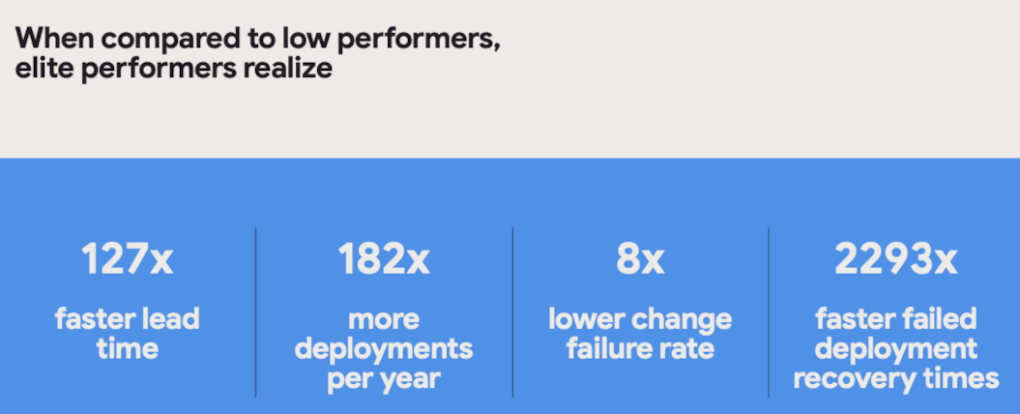
<p>DORA — DevOps Research and Assessment institute release an annual “State of DevOps”. report. They have curated four core metrics that they use to divide development teams into four performance levels: Elite, High, Medium and Low.</p>

<p>The four DORA metrics:</p>

<ul>
  <li>Change lead times</li>
  <li>Deployment frequency</li>
  <li>Change failure (and rework) rate</li>
  <li>Failed deployment recovery time</li>
</ul>

<div class="pic caption pic center medium">
  
  
  <a href="/stories/state-of-devops-2024/">
    
    <img src="/assets/responsive/1020/dora-businesscase.png" srcset="/assets/responsive/128/dora-businesscase.png 128w,/assets/responsive/255/dora-businesscase.png 255w,/assets/responsive/510/dora-businesscase.png 510w,/assets/responsive/1020/dora-businesscase.png 1020w," alt="DORA 2024" class="pic pic center medium" /></a>Lead time up 127 times when comparing Elite and Low performers, The DORA survey from 2024 relies on 39K respondents. Click on the image to go to the post, scrutinizing the results of the 2024 State of DevOps report</div>

<p>The distance between Elite and Low performers is mind blowing, so from that perspective <em>everybody</em> should want to become an Elite performer. But in reality lean concepts — and even DORA — argues that the shift is not achieved by simply <em>doing</em> something differently, it’s achieved by <em>thinking</em> differently.</p>

<p>Of course <em>long-term system thinking</em> is the foundation of this mental shift, but also the <em>pull</em> that must replace the <em>push</em> and the recognition of <em>Developer Experience</em> as a core performance factor and the effect of <em>transformational leadership</em> which opens up a whole new field of lean management principles and problem oriented didactics are all examples of <em>thinking</em> that does not always play well with the established short-term Iron Triangle approach.</p>

<p>It’s not necessarily a quick fix, but it is definitely a fun one.</p>

<p><strong><em>If you are in a position where you think you could use a second opinion on your Software Development Life Cycle don’t hesitate to reach out and let’s have a chat - no charge!</em></strong></p>

<p><a href="https://calendly.com/lakruzz" class="btn btn--warning" target="_blank" title="Opens in a new tab">Book a call</a></p>

<hr />
<div class="footnotes" role="doc-endnotes">
  <ol>
    <li id="fn:smed">
      <p>Toyota’s SMED (Single-Minute Exchange of Die) principle is a lean manufacturing methodology designed to drastically reduce the time it takes to complete equipment changeovers or production setups. Due to the extremely high (positive) impact on Cycle Time, it’s considered justified even if the development of that improvement may assume quite an extensive effort. <a href="#fnref:smed" class="reversefootnote" role="doc-backlink">&#8617;</a></p>
    </li>
  </ol>
</div>]]></content><author><name>Lars Kruse</name></author><category term="services" /><summary type="html"><![CDATA[The takt concept derives from lean manufacturing, but how does it apply to lean software development]]></summary></entry><entry><title type="html">Continuous Delivery in regulated, safety-critical or high-risk products</title><link href="https://www.lakruzz.com/stories/cd-in-regulated-prod/" rel="alternate" type="text/html" title="Continuous Delivery in regulated, safety-critical or high-risk products" /><published>2025-12-30T00:00:00+00:00</published><updated>2025-12-30T00:00:00+00:00</updated><id>https://www.lakruzz.com/stories/cd-in-regulated-prod</id><content type="html" xml:base="https://www.lakruzz.com/stories/cd-in-regulated-prod/"><![CDATA[<p><img src="/assets/images/posts/lakruzz.png" alt="image-center" class="align-center" width="50%" /></p>

<p class="kicker">I work as a passionate Continuous Delivery expert with more than 20 years experience in the field. If you are working in a regulated, safety-critical or high-risk product and your Software Development Life Cycle needs optimization — or just a second opinion — I can help</p>

<p class="fact right small"><strong>About me</strong><br />I hold a M.Sc. in Computer Science and Communication theories from my youth.<br />   Later in my career I also pursued a Master in Business Coaching — <em>leadership through conversation</em>.<br />   I founded and led Praqma in 2007; a consulting bureau specialized in Continuos Delivery and DevOps.<br />   I sold the company in 2018. At that time we were ~50 specialized consultants in three countries (DK,N,S).</p>

<p>Throughout my entire career I have dedicated my focus on organizing software developer routines and chores in a way that fosters software with quality built-in — often GxP grade (life science), safety-critical (manufacturing industry) and high-trust (finance) and often with the added complexity of  hardware-in-the-loop. At the core in achieving this I build a continuous flow in software deliveries, through a high degree of autonomation and automation;  <em>anything-as-code</em>.</p>

<p>I have a passion — and profound knowledge — in utilizing and adopting DevOps and DevX principles in software development processes, but most importantly I adhere to lean principles. I have many years of experience in adapting both lean manufacturing principles and lean management principles to <em>lean software development</em>.</p>

<p>The catch-all term for this approach is <em>Continuous Delivery.</em></p>

<p>Despite my general focus on advisory, leadership and strategies — I still write code every day and I contribute actively to the tactical implementation. I believe in leading by example.</p>

<h2 id="quality-by-design">Quality-by-Design</h2>

<blockquote>
  <p><em>a systematic approach to development that begins with predefined objectives and emphasizes product and process understanding based on sound science and quality risk management.</em></p>
</blockquote>

<p>Quality-by-Design (QbD) is a software development discipline that is widely adapted in regulated software productions — and even in safety-critical and high-risk areas that may not be strictly regulated by an external body, but nevertheless work by the same self-imposed strict quality measures. Some of the more commonly known trademarks of Quality-by-Design in everyday software development workflow manifests as:</p>

<ul>
  <li><strong>V-model</strong> — for verification and validation</li>
  <li><strong>Traceability</strong> — all changes must trace to a specific requirement — and to a specific verification</li>
  <li><strong>Segregation of duties</strong> — a general four-eye principle</li>
  <li><strong>Code classification</strong> — not all code changes impose the same level of risk</li>
  <li><strong>Releases management</strong> — Strict control over the deployment process, only authorized versions reach the production environment</li>
</ul>

<p>In many ways QbD is the direct opposite paradigm to the emerging <em>vibe coding</em> trend. In Quality-by-Design we’re not <em>hacking</em> to explore exciting what-if scenarios. Instead we strive to <em>prove</em> that the code is working as intended, solving the specific problems that we <em>analyzed</em> in forehand.</p>

<p>Unfortunately, in many cases these Quality-by-Design trademarks also end up getting a lot of beating and are often accused of creating a rigid process.</p>

<p><strong>The criticism I hear:</strong> — <em>Waterfall processes, Big Design Up Front, bureaucratic over-registrations, unfree procedures, long-lived feature branches, fragmented complex dependency maps, long wait states, rubber stamp peer-reviews, way too many hand-overs, release procedures that requires intense heroic over-time work with countless of loop-back, tedious paperwork and coordinations between too many parties which lead to more hand-overs and more idle time.</em></p>

<p>Throughout my career as Continuous Delivery consultant I’ve seen many software development teams that suffer from some — or all — of the dysfunctions above and at the same time excuse it with:</p>

<blockquote>
  <p><em>“due to the the regulated process we are forced to work like this”</em>.</p>
</blockquote>

<p>It is my own observation that regulated environments and other strict QbD implementations usually suffer way harder than other environments from bad performance in all of the four core DORA metrics:</p>

<ul>
  <li>Change lead times</li>
  <li>Deployment frequency</li>
  <li>Change failure (and rework) rate</li>
  <li>Failed deployment recovery time</li>
</ul>

<p>But I also find this to be quite a paradox. On paper Quality-by-Design has a huge potential to become a DORA high-performer; <em>observability</em> and <em>process understanding</em> is precisely what fuels Elite DevOps.</p>

<p>Quality-by-Design aligns naturally with lean manufacturing concepts like a hand in a glove; Lean manufacturing has several concepts specifically designed to build quality in at the source, as opposed to glue it on as an afterthought.</p>

<p><strong>Jidoka</strong> — “Autonomation” a made-up word that implies automation with autonomy as a human.</p>

<p>A <strong>one-piece-flow</strong> that is the incarnation of minimize-work-in-progress, each product item is started and continued until it’s completely done - like a conveyer belt. The one-piece-flow is specifically designed to make problems surface early, so they can be dealt with at the source.</p>

<p>The <strong>andon cord</strong> a line that runs throughout the entire factory, when a defect is detected the andon is pulled which brings the entire process to a stop until it’s fixed. No process can pass a defect on to the next.</p>

<p><strong>S.M.E.D</strong> Single-minute-exchange-of-die — a concept used in lean manufacturing methodology that references a true iconic story that drastically reduce the time it takes to complete equipment changeovers or production setups. Due to the extremely high (positive) impact on the outcome. S.M.E.D. is referring to the general principle that even large endeavors are considered justified despite extensive effort and cost, if the long-term system outcome is proportional.</p>

<p>In lean software development:</p>

<ul>
  <li><strong>Jidoka</strong> implies <em>a lot</em> of automation at <em>all</em> levels of the V-model, simply <em>shift-left</em>.</li>
  <li><strong>The one-piece-flow</strong> and <strong>the andon cord</strong> becomes the fabled CI/CD pipeline.</li>
  <li><strong>The S.M.E.D. principles</strong> becomes a host of tools, scripts, plugins, extensions, templates that we develop specifically to serve and standardize our <em>own</em> process.</li>
</ul>

<p>I have made it my hallmark to take the postulated rigidness out of configuration management, traceability, thorough testing, release management and  quality-by-design principles and maintaining all these virtues by combining them with Continuous Delivery principles to create a constant flow of software deliveries with high throughput and stability.</p>

<p>The end-goal is to enable <em>deployment-on-demand</em> with all quality, stability and QbD compliancy intact.</p>

<h2 id="continuous-delivery-in-qbd-context">Continuous Delivery in QbD context</h2>

<p class="fact right small"><strong>Companies I aided</strong><br />
In my capacity as a Continuous Delivery consultant I have assisted the following companies (the time span is 20+ years):<br /><br />
<em>Ericsson AB, Sony-Ericsson, Nordea, ATP, Novo Nordisk, Grundfos, Danfoss Drives, Rational Software, Volvo Trucks, Novelda, Radiometer, Alm Brand, TDC, Everllence (MAN es), Tetra pak, Oticon, Tieto Finance, William Demant, Kamstrup, LM Ericsson, GitHub, Siemens Gemesa, Programming Research QA, AP Pension, Microchip (Atmel), Terma, Brüel &amp; Kjær Sound and Vibration, Arla foods, BankData, Santander Consumer Bank, Styrelsen for IT &amp; Læring, 3Shape, Schlumberger, Universal Robots, Cryptera, Danmarks Radio, BK Ultrasound, Yxlon International</em></p>

<p>As an incarnated Continuous Delivery expert I am passionate about creating flow and automate — everything. Here’s an array of stuff that I have automated, and turned into silent background processes over time:</p>

<p><em>Task management, branching strategies, semantic versioning, telemetry, metrics, visualizations, release notes, packaging, static code analysis, product dependency maps, unit tests, integrations tests, end-2-end tests, fuzzy tests, performance tests, regression tests, test data synthesis, production-like environments, developer environments setup, containerization, onboarding, offboarding, digital twins, fast-forward merge to main, peer-reviews, infrastructure, builds, security scans, deployments, releases, documentation.</em> — I could go on.</p>

<p>When scrutinized, some of these steps may at first seem quite controversial to try to automate in a traditional Quality-by-Design process. A few examples; I often get that push back that <em>“keeping the main integration branch in an always shippable state”</em> is impossible in a regulated process and that <em>“removing the costly rubber stamp peer-review”</em> is not possible due to QA policies and compliance with regulations.</p>

<p>While I do admit and agree that some of these automation efforts can approach <em>S.M.E.D sized</em> endeavors in most regulated environments, I have nevertheless proven at several occasion that even hard-to-crack nuts like these can be overcome.</p>

<p>I dare you:</p>

<ul>
  <li><strong>Keeping the integration branch in an always shippable state</strong> — <em>does not imply</em> that everyone is hacking directly on <code class="language-plaintext highlighter-rouge">main</code>.</li>
  <li><strong>Removing the ritual rubber stamp peer-review</strong> — <em>does not imply</em> that you unconditionally sacrifice the four-eye principle.</li>
  <li><strong>Skipping the Big Design Up Front and allowing end-users to get a strong voice in a Participatory Design process</strong> — <em>does not imply</em> that the V-model is cast aside.</li>
  <li><strong>Utilizing AI and prompt engineering in your process</strong> — <em>does not imply</em> that you are merely <em>vibe coding</em> and hence scope creeping away from requirements.</li>
  <li><strong>Utilizing Open Source and maybe even releasing it yourself</strong> - <em>does not imply</em> that your Intellectual Property is jeopardized or that you expose yourself to a security risk.</li>
  <li><strong>Dropping hard deadlines and adhering to #NoEstimates</strong> — <em>does not imply</em> that everything is up in the air and all delivery plans are void.</li>
  <li><strong>Firing red-tape heavy weight tools like Jira and Azure DevOps and swap to a DevX driven developer-first stack</strong> - <em>does not imply</em> that you are violating neither GDPR, NIS2 nor QbD principles.</li>
  <li><strong>Bringing the deploy frequency to <em>on-demand</em></strong> — <em>does not imply</em> that you loose strict control over the deployment process.</li>
</ul>

<div class="pic caption pic right small">
  
  
  <a href="/stories/githubs-enfant-terrible/">
    
    <img src="/assets/responsive/1020/github-enfant-terrible.png" srcset="/assets/responsive/128/github-enfant-terrible.png 128w,/assets/responsive/255/github-enfant-terrible.png 255w,/assets/responsive/510/github-enfant-terrible.png 510w,/assets/responsive/1020/github-enfant-terrible.png 1020w," alt="GitHub's Enfant Terrible" class="pic pic right small" /></a>In this post I argue why GitHub's Pull Request are flawed in a strict configuration managemnt context, making it impossible to maintain the required traceability - and what to do about it</div>

<p>I know that many developers who are used to work in regulated environments might instinctively feel an urge to call me out and claim that I’m off. Or miscredit me for not knowing what I’m talking about. But I do. I’m definitely not advocating abandoning QbD principles. I’m merely showing an optimized path to walk to the same goal.</p>

<p>I have written a good handful of blog posts diving into the nitty gritty details on these topics, even presented at conferences on quite a few of the topics as well. But more importantly I have actually implemented all of these concepts in QbD processes. If you want to dive into any of these specific topics then please reach out to me; I’d be happy to elaborate, share and demonstrate.</p>

<p>My point is simply, that it pays out to leave the traditional <em>construction</em> paradigm in software development and enter in to a lean <em>software as a factory<sup id="fnref:software-factory"><a href="#fn:software-factory" class="footnote" rel="footnote" role="doc-noteref">1</a></sup></em> paradigm instead. Especially in regulated software development environments, where lean concepts are usually already very well understood and accepted. I’ve seen the epiphany happen in real time several times:</p>

<blockquote>
  <p><em>“Aaah! So we’re essentially making software the same way we make hardware!”</em>.</p>
</blockquote>

<p><em>“Yes!”</em> — It makes good senses in general, but especially when there is hardware-in-the-loop. Aligning to lean processes helps build mutual understanding across organizational silos.</p>

<h2 id="flow">Flow</h2>

<div class="pic caption pic right small">
  
  
  <a href="&lt;https://www.linkedin.com/pulse/say-ai-again-i-dare-you-lars-kruse-lrhbf&gt;" target="_blank">
    
    <img src="/assets/responsive/1020/i-dare-you.png" srcset="/assets/responsive/128/i-dare-you.png 128w,/assets/responsive/255/i-dare-you.png 255w,/assets/responsive/510/i-dare-you.png 510w,/assets/responsive/1020/i-dare-you.png 1020w," alt="Say AI one more time - I dare you" class="pic pic right small" /></a>In this post I argue why GitHub's Pull Request are flawed in a strict configuration managemnt context, making it impossible to maintain the required traceability - and what to do about it</div>

<p>It is generally recognized within lean methodology, that <em>mura</em> (unevenness) is the cause for most of the <em>muri</em> (overburdenness) which drives <em>muda</em> (wastefullness).</p>

<p>Therefore creating flow — <em>optimizing the value stream</em> – is the most important condition to establish. This is true within <em>lean software development</em> too.</p>

<p>As DevOps Research and Assessment institute’s (DORA) annual “State of DevOps” report has established several times:</p>

<blockquote>
  <p><em>“Throughput beats Stability<sup id="fnref:100pct"><a href="#fn:100pct" class="footnote" rel="footnote" role="doc-noteref">2</a></sup>”</em></p>
</blockquote>

<p>To optimizing the value stream is the essence of long-term system thinking — nothing is more important.</p>

<p>Optimizing the value stream eliminates most problems, not just in the software product itself, which even gets higher quality and stability as a side effect, but it also has a positive effect in the team where flow alleviate cognitive load and burnout. As we progress, more and more processes becomes automated and hereby standardized. And slowly but surely they are converted to non-disturbing background processes, which enables the software developers to keep the eye on the ball; to analyze problems and to solve problems.</p>

<p>As Mary &amp; Tom Poppendieck poetically describes in <em>“Lean Software Development”</em> in 2002:</p>

<blockquote>
  <p><em>“Either you in process of analyzing and understanding a problem<br />
— Or you are in process of implementing and solving a problem<br />
— Or you are in process of wasting your time”</em></p>
</blockquote>

<p>My preferred way of working, when optimizing workflows and developing software products is based on kanban upstream and downstream boards, which are held continuously prioritized by risk and effect. To minimize work in progress, to establish Participatory Design and short feedback loops with end-users, to create a collaborative Open Source like sentiment adhering to #NoEstimates and XP principles — and then to compensate the business for lack of deadlines by maintaining ambitious but realistic delivery plans - often in the form of roadmap or upstream kanban boards.</p>

<h2 id="transformational-leadership">Transformational Leadership</h2>

<p>My general position when it comes to exercising leadership can be summarized in the concept <em>Transformational Leadership;</em> With a focus that the team should be led from within, by a playing coach or a role model, who lives the same values as the team strive to achieve in general. The tools in achieving this are centered around <em>motivation</em> and <em>stimulation</em>. Often anchored in lean management principles and problem oriented didactics. We must learn and develop <em>while</em> we work.</p>

<h2 id="how-do-we-get-started">How do we get started</h2>

<p>Maybe you already have a concrete situation in mind where you see me as a possible fit. Great — don’t hesitate to reach out.</p>

<p><a href="https://calendly.com/lakruzz" class="btn btn--warning" target="_blank" title="Opens in a new tab">Book a call</a></p>

<div class="pic caption pic right small">
  
  
  <a href="/stories/the-full-assessment/">
    
    <img src="/assets/responsive/1020/codemamo.v2.21.png" srcset="/assets/responsive/128/codemamo.v2.21.png 128w,/assets/responsive/255/codemamo.v2.21.png 255w,/assets/responsive/510/codemamo.v2.21.png 510w,/assets/responsive/1020/codemamo.v2.21.png 1020w," alt="The Full CD Assessment" class="pic pic right small" /></a>During my time in Praqma I developed the <em>Continuous Delivery Metric Model</em>; A tool used to help companies assess current state of their SDLC Value Stream and come up with a road map for improvements</div>

<p>Below I have sketched a three-step approach I have used at several clients over the time, think of it as inspiration — I can adapt to your organization’s need in any way you wish. An alternative, even less formal first encounter, could be that I come by you and your team and offer <a href="/contact/#get-a-free-workshop-for-your-team">a free inspirational workshop</a>.</p>

<ol>
  <li>Genchi Genbutsu (observation, analysis, research, interviews, demo, workshops, value stream mapping)</li>
  <li>Reporting and roadmap</li>
  <li>Kaizen kultur</li>
</ol>

<h3 id="genchi-genbutsu">Genchi Genbutsu</h3>

<p>I suggest an initial phase (Genchi Genbutsu) which typically runs for a week or two, dependant on the complexity of your current as-is work process.</p>

<p><em>Genchi Genbutsu</em> is a lean term; “go-see-for-yourself” which is the foundation of lean problem solving; you go to the Gemba “where the work is done” and systematically observe and analyze with the purpose of suggesting and balancing possible improvements.</p>

<p>In this phase, it is also important to establish relations to those in your organization who shall <em>own</em> the results and outcome. As a consultant or guest in your organizations it’s imperative that the formal ownership is placed with someone in your own organization, with sufficient level of decision power and seniority. The person of persons who has ownership will work with me in a close relation in this part of the assignment, and contribute in the planning, observing, analysis, research, interviews etc.</p>

<h3 id="reporting-and-roadmap">Reporting and roadmap</h3>

<p>The initial phase is concluded by a summary report and recommendation to a roadmap or an upstream kanban board. It’s a short phase, just one or two meetings with stakeholders, with the primary purpose to mark the transition from Genchi Genbutsu to the continuous improvement phase.</p>

<h3 id="kaizen-culture">Kaizen Culture</h3>

<p>Immediately hereafter an informal but facilitated kaizen (Continuous Improvement) culture is established. In this culture, changes are introduced as deliberately small continuous improvement to existing everyday chores and processes, carefully designed to be non-intrusive way that does not create anxious big-bag situations or raises the cognitive load on any team members.</p>

<p>Kaizen means “good change” in the implied meaning “small change”. It is about <em>changing the wheels on the bud — while it’s rolling</em>.</p>

<p>Focus is on an ongoing prioritization (upstream kanban board) of possible tasks and improvement with the aim to gain the largest possible effect with the smallest possible change. And then keep a focused implementation strategy through minimizing work in progress in the kanban downstream board.</p>

<p>In the beginning of this phase I will personally co-work with team members on the individual improvements, and keep focus on implementations not creating <em>disturbance</em> but <em>improvements</em> of existing processes. This focus may require some adjustment and getting-used-to. I will take dedicated responsibility for the implementation and the outcomes until the culture is understood and adopted.</p>

<p>It is likely that changes will touch on and involve several teams or departments. I will strive to work as a catalyst. I will start and finish one task at a time, but shift frequently between teams so the kaizen culture will be built and balanced between the teams.</p>

<p>We will coordinate and evaluate regularly among the teams in joint events like retrospectives, pulse checks but most importantly by gathering metrics and telemetry on actual progress. Measuring on the four code DORA metrics is usually a good place to start.</p>

<p><a href="https://calendly.com/lakruzz" class="btn btn--warning" target="_blank" title="Opens in a new tab">Book a call</a></p>

<h3 id="practicalities">Practicalities</h3>

<p>My engagement can range from just a few inspirational workshops to year-long engagements. And I have had several clients where I continued in an advisory role after my day-to-day engagement ceased.</p>

<p>After more than 20 years as a Continuous Delivery expert, and with many of them in a capacity as employer, I have a very large network of professional like-minded and I do have the capability to offer to take lead and responsibility and scale up on <em>S-M.E.D. sized endeavors</em> with curated freelancers, collaboration partners or even student workers for grunt work or Open Source contributions if necessary.</p>

<p>I run a tight ship with a lean cost structure, hence my pricing is attractive and easily 20-60% less than I charged when working in the same capacity in a Management Consulting Bureau. My compensation is adapted to the extend of the contract we make.</p>

<p>I strive to be easy to be onboarded …and offboarded.</p>

<hr />
<div class="footnotes" role="doc-endnotes">
  <ol>
    <li id="fn:software-factory">
      <p>LinkedIn post on <a href="https://www.linkedin.com/posts/lakruzz_the-toyota-way-activity-7402012682024988673-AH4a" target="_blank">the relevance of the Toyota Way in software</a> <a href="#fnref:software-factory" class="reversefootnote" role="doc-backlink">&#8617;</a></p>
    </li>
    <li id="fn:100pct">
      <p>An interesting proof from DORA, that <a href="https://www.linkedin.com/posts/lakruzz_devx-doracommunity-devopsculture-activity-7272643703482052608-QxwP" target="_blank">Throughput beast Stability</a> <a href="#fnref:100pct" class="reversefootnote" role="doc-backlink">&#8617;</a></p>
    </li>
  </ol>
</div>]]></content><author><name>Lars Kruse</name></author><category term="services" /><summary type="html"><![CDATA[A speciality I have worked in and refined for more than two decades. Here's how I approach it]]></summary></entry><entry><title type="html">Lakruzz’ Law</title><link href="https://www.lakruzz.com/stories/lakruzz-law/" rel="alternate" type="text/html" title="Lakruzz’ Law" /><published>2025-12-12T00:00:00+00:00</published><updated>2025-12-12T00:00:00+00:00</updated><id>https://www.lakruzz.com/stories/lakruzz-law</id><content type="html" xml:base="https://www.lakruzz.com/stories/lakruzz-law/"><![CDATA[<p><img src="/assets/images/posts/lakruzzlaw/lakruzzlaw-trimmed.jpg" alt="image-center" class="align-center" width="80%" /></p>

<p class="kicker">Do you recall Conway’s Law: <em>“Any organization that designs a system (defined broadly) will produce a design whose structure is a copy of the organization’s communication structure.”</em></p>

<p>It was made famous by Melvin Conway’s friend and colleague Fred Brooks in the fabled book “The Mythical man month” which predates any mention of <em>DevOps</em> or <em>SAFe<sup>®</sup>.</em> Not even the terms <em>lean</em>, <em>agile</em> or <em>scrum</em> was invented when Brooks published his book in 1972.</p>

<p>Conway’s Law mentions “design” and “systems”. The simile “architecture” obtained from the building/construction domain wasn’t introduced in software development in 1967 where Conway first made the statement. But today we would refer to it as System Architecture. The gist of Conway’s law is really:</p>

<blockquote>
  <p>Show me your system architecture chart, and I can back-track to your organization chart</p>
</blockquote>

<p>During my work as an IT consultant I’ve come across what feels like thousands of system architectures, and I’ve always been stoked about how true that prediction really is. How siloed organizations actually work. Most developers (back then of course) would rather build interfaces to their colleagues, than to collaborate with them. The ruling thought among the average developer (not you, but the others) seem to be: <em>“I’ll put any piece of code that derives from a colleague in my own department in the module or component, but anything else will have to be fenced out and only included through some kind og interface”.</em></p>

<p>It really gives the die hard rule-of-thumb in system architecture <em>High Cohesion, Low Coupling</em> a completely different flavor doesn’t it?</p>

<p>When analyzed, it seems to be a collaboration issue causing this effect. Software is complex. It calls for a lot of communication on the side. If people aren’t close by, if they don’t share lunch and coffee on a daily basis, then they can’t understand each others code.</p>

<p>…back then.</p>

<h2 id="but-then-came-devops-to-the-rescue">But then came <em>DevOps</em> to the rescue!</h2>

<p>Yes, and before that <em>agile</em>, <em>scrum</em>, <em>lean software development</em>, <em>Continuous Delivery</em> and later <em>serverless</em>, <em>containers</em> and <em>cloud native</em>.</p>

<p>So now we’re all OK. Phhhew!</p>

<p>DevOps tear down the silos. DevOps magically makes Dev and Ops love each other and become united in a holistic flow of high quality software. And not just Dev and Ops. The DevOps Culture makes <em>everybody</em> love <em>everybody</em> and it tears down <em>all</em> silos in the organization. So luckily modern software products don’t suffer from that problem stated by Conway’s Law anymore.</p>

<p>Or do they?</p>

<p>One could argue, that it <em>is</em> probably getting just a tiny bit harder to predict an organization chart simply by the glance of an architectural drawing of the system. There architectures is more distributed, smaller components, more interfaces, which are more efficient. But personally I believe it’s to be less due to DevOps culture and agile method frameworks and more a consequence of the combination of the nowadays more common distributed nature of companies. The fact that contemporary tool stacks are more heavily utilizing REST and GraphQl API’s. The popularity of hosted collaboration platforms like Azure DevOps, GitHub, GitLab and Bitbucket.</p>

<p>Interfaces have improved and organizations has become more diffuse - and so has the system architectures; Conway’s law still holds.</p>

<p>But I’ve made the observation that <em>another</em> tell has snug into almost every snippet of system architecture out there, which will also reveal quite a lot about the organization behind the software release: It’ about the tool stack itself.</p>

<p>So I’ll postulate <strong>Lakruzz’ Law:</strong></p>

<blockquote>
  <p>Any organization that sets out on a certain tool stack (processes included) will remain on that exact stack until eternity or end-of-life whichever comes first.</p>
</blockquote>

<p>The observation, stated as my law above, is essentially nothing but a tool stack variant of the Conway’s original Law.</p>

<p>I often find that a company’s tool-stack and process framework is like a snapshot back in time. It captures what was contemporary and <em>comme il faut</em> at the time when the software product was being conceived.</p>

<p>Companies seem to have picked their <em>modern</em> tool stack at the time of creation. Believing that <em>“Surely this tool stack will carry us all the way into the future and beyond! - what could possibly go wrong?”</em>. But sadly; almost <em>any</em> company is then tied down by overwhelming software complexity and technical debt. Soon enough their (any) tool stack fall back to appeal only to <em>late majority</em> and <em>laggards.</em> The rest has moved on. And they simply don’t have the resources to keep up with modern stacks.</p>

<p>Based on a listing of the tool stack and the process method frameworks I can usually predict intel about a company like:</p>

<ul>
  <li>When was the company founded (or start utilizing IT)?</li>
  <li>What type of management or leadership do they have?</li>
  <li>What’s their recruitment and retention strategy?</li>
  <li>How are they funded?</li>
  <li>What’s their market fit and user segment?</li>
  <li>What’s their workplace policy?</li>
  <li>Do the depend on contract workers?</li>
  <li>Do people like working there?</li>
</ul>

<p>I’ve seen traditional hipster/hacker/hustler startups with great success and hockey sticking valuations who are equally predictable: After onboarding only the first few four-digit number of users, they are helplessly tied to their hack of Postgres database, their docker containers, and their Python scripts. And they will never leave it.</p>

<h2 id="really-is-there-no-escape">Really? Is there no escape?</h2>

<p>There is!</p>

<ul>
  <li>If the company truly embraced IT as an enabler, as opposed to a cost center that constantly need to be minimized or contained.</li>
  <li>If they encourage developers to remain playful and exploratory about emerging technologies.</li>
  <li>If’ they’re not afraid of releasing and deploying code at the speed developers can actually produce it.</li>
  <li>If they can build quality in - as opposed to gluing it on and restrain from building up technical debt.</li>
</ul>

<p>Then their tool stack is probably constantly being added to and subtracted from. Then they would be progressing and the tool stack wouldn’t merely be a snapshot of their time of birth.</p>

<p>But:</p>

<p class="kicker">It’s a small portion of organizations, who are not being eaten by Software<br />
But rather eat software for breakfast</p>

<p>A place that eats software for breakfast? That’s a place I’d like to work!</p>]]></content><author><name>Lars Kruse</name></author><category term="lakruzzlaw" /><category term="conwayslaw" /><category term="toolstacks" /><category term="devops" /><summary type="html"><![CDATA[Any organization that sets out on a certain toolstack (processes included) will remain on that exact stack until eternity or end-of-life whichever comes first.]]></summary></entry><entry><title type="html">The Toyota Way</title><link href="https://www.lakruzz.com/stories/the-toyota-way/" rel="alternate" type="text/html" title="The Toyota Way" /><published>2025-12-03T00:00:00+00:00</published><updated>2025-12-03T00:00:00+00:00</updated><id>https://www.lakruzz.com/stories/the-toyota-way</id><content type="html" xml:base="https://www.lakruzz.com/stories/the-toyota-way/"><![CDATA[<p><img src="/assets/images/posts/toyotaway/toyotaway-2nd.png" alt="image-center" class="align-center" width="80%" /></p>

<p class="kicker">The following is a short summary Jeffery Liker’s book “The Toyota Way” 2<sup>nd</sup> edition.</p>

<p>This article is meant as an introduction for anyone who wants to learn the very basics of The Toyota Way - enough the get curious, get discussions going and start reflecting and comparing to other methodologies and principles. It includes a slide deck, with a slide for each of the 14 principles. Some parts of this article are 1:1 quotes from Jefferey Likers 2<sup>nd</sup> edition of “The Toyota Way”. It’s clearly marked which parts.</p>

<h2 id="the-toyota-production-system-tps">The Toyota Production System (TPS)</h2>

<dl>
  <dt>NOTE</dt>
  <dd>
    <p><em>This first section — introducing the house — is copied straight over from Jeffrey’s own introduction in the book <a href="/assets/pdf/the-toyota-way-2nd-ed-jeffrey-liker.pdf" title="Download the entire book as  .PDF" target="_blank">“The Toyota Way” 2<sup>nd</sup> edition</a>  (pages xxi- xxiii)</em></p>
  </dd>
</dl>

<p><img src="/assets/images/posts/toyotaway/toyotaway-house.png" alt="image" width="350" align="right" /></p>

<p>A cornerstone of the Toyota Way is “challenge,” and there was no shortage of challenges. When Toyota was struggling to survive in its early years, with few resources and very low demand, Taiichi Ohno was asked to find a way to match Ford Motor Company’s productivity, which, owing to its size and economies of scale, was about nine times greater than that of Toyota. Faced with a seemingly impossible task, Ohno did what every Toyota leader has done before and after — go to the gemba, experiment, and learn. And like other great Toyota leaders he succeeded. He built on the core philosophies and methods of founders Sakichi Toyoda and his son Kiichiro Toyoda to develop the framework now called the Toyota Production System.</p>

<p>Ohno originally did not want TPS drawn as a picture, because he said TPS was something live on the shop floor, not something dead in a drawing. He said, “If we write it down, we kill it.” Nonetheless, it was eventually drawn as a house with two pillars and a foundation, a structure that is only as strong as all the parts working together.</p>

<p>The in-station quality pillar is attributed to Sakichi Toyoda, who invented the first fully automated loom for making cloth. One of his many inventions along the way was a device that automatically stopped the loom when a single thread broke, which called attention to the problem so humans could fix it as quickly as possible. He called this “jidoka,” a machine with human intelligence. These days it is often referred to as in-station quality—which means, don’t let a defect escape your station. The second pillar is just-in-time, attributed to Kiichiro Toyoda, who founded the automotive company. He declared Toyota would “remove slack from all work processes” and follow the principles of JIT — a move that was necessary at the time just to avoid bankruptcy. He designed detailed processes for doing this. The foundation of the house in the figure, or the company by extension, is operational stability, which means a level, stable workflow. A smooth and steady flow of work is necessary to have any chance of achieving just-in-time flow and fixing problems as they occur. And at the center of these processes are flexible, capable, motivated people who are devoted to continually improving.</p>

<p>The missing safety net — lots of inventory (or time or information buffers) - means problems show themselves very quickly and must be solved quickly. Built-in quality comes about as abnormalities are identified by every team member and addressed before they can bleed out to later processes or to the customer. As the problems are solved, the foundation of stability becomes stronger, allowing for less inventory, better flow, and a smaller number of problems, most of which can be effectively controlled as they occur.</p>

<p>At the center of surfacing and solving problems are developed people. They are the brains doing the problem solving. Take away their brains and motivation to improve, and what you have left is a system that hopelessly runs itself into the ground. Continuous improvement means getting better every day and is the driver for building a sustainable enterprise. Only those at the gemba can understand the problems fast enough to react quickly. Continuous improvement depends on a different paradigm of the role of the human—all humans are problem detectors and problem correctors—thinking scientifically.</p>

<dl>
  <dt>NOTE</dt>
  <dd>
    <p><em>Done with quoting Jeffery Liker - if you Like (pun intended 🤷‍♂️) you can even skip the rest of this article too and  - head straight over to read the appendix “Executive summary …” (pages 377-382 ) in Jeffery Liker’s book <a href="/assets/pdf/the-toyota-way-2nd-ed-jeffrey-liker.pdf" title="Download the entire book as  .PDF" target="_blank">“The Toyota Way” 2<sup>nd</sup> edition</a></em></p>
  </dd>
</dl>

<h2 id="4p-model">4P model</h2>

<p>The 4P model of the Toyota Way is a framework that summarizes the 14 management principles of Toyota’s organizational culture. The 4Ps stand for Philosophy, Process, People, and Problem Solving.</p>

<p><img width="602" alt="image" src="/assets/images/posts/toyotaway/toyota-4p.png" /><br clear="both" /></p>

<h3 id="philosophy">Philosophy</h3>

<p>This is the long-term vision and mission of Toyota, which guides its decision-making and actions. It is based on the idea of creating value for customers, society, and the economy. T principle in this category is:</p>

<ol>
  <li>Long-term system thinking</li>
</ol>

<figure class="third ">
  
    
      <a href="/assets/images/posts/toyotaway/ttc-ttw.png">
          <img src="/assets/images/posts/toyotaway/ttc-ttw.png" alt="The Toyota Way" />
      </a>


      <a href="/assets/images/posts/toyotaway/ttc-ttw-0.png">
          <img src="/assets/images/posts/toyotaway/ttc-ttw-0.png" alt="The Toyota Way" />
      </a>


      <a href="/assets/images/posts/toyotaway/ttc-ttw-1.png" title="This principle emphasizes the importance of having a clear vision and purpose that guides the organization's actions and decisions. It also encourages the organization to consider the impact of its actions on society, the environment, and future generations. By basing management decisions on a long-term philosophy, the organization can achieve sustainable growth and avoid short-sightedness.">
          <img src="/assets/images/posts/toyotaway/ttc-ttw-1.png" alt="The Toyota Way" />
      </a>


    <figcaption>Click the slides to read about the details of each principle
</figcaption>
  
</figure>

<break clear="left" />

<h3 id="process">Process</h3>

<p>This is the way Toyota designs, operates, and improves its processes to ensure quality, efficiency, and customer satisfaction. It is based on the concept of eliminating waste and maximizing value. Some of the principles under this category are:</p>

<ol start="2">
  <li>Continuous Flow</li>
  <li>Pull</li>
  <li>Level</li>
  <li>Standardized Processes</li>
  <li>Design-Build in Quality</li>
  <li>Visual Control</li>
  <li>Technology to Support People and Processes</li>
</ol>

<figure class="third ">
  
    
      <a href="/assets/images/posts/toyotaway/ttc-ttw-2.png" title="This principle advocates the elimination of waste and inefficiencies in the production process, such as overproduction, inventory, waiting, defects, and unnecessary motion. By creating a continuous flow of value from the supplier to the customer, the organization can reduce lead time, improve quality, and increase customer satisfaction. Moreover, by exposing problems as they occur, the organization can quickly identify and solve them, rather than hiding or ignoring them.">
          <img src="/assets/images/posts/toyotaway/ttc-ttw-2.png" alt="The Toyota Way" />
      </a>


      <a href="/assets/images/posts/toyotaway/ttc-ttw-3.png" title="This principle suggests that the organization should produce only what is needed by the customer, when it is needed, and in the amount needed. By using 'pull' systems, such as kanban, the organization can synchronize its production with the customer demand, and avoid overproduction, which leads to excess inventory, waste, and obsolescence. Furthermore, by using 'pull' systems, the organization can respond more flexibly and quickly to changes in the market.">
          <img src="/assets/images/posts/toyotaway/ttc-ttw-3.png" alt="The Toyota Way" />
      </a>


      <a href="/assets/images/posts/toyotaway/ttc-ttw-4.png" title="This principle advises the organization to balance the workload across the production process, and avoid fluctuations and unevenness (mura). By leveling out the workload, the organization can reduce waste, improve quality, and enhance efficiency. Additionally, by leveling out the workload, the organization can prevent overburdening (muri) of its people and equipment, and avoid stress, fatigue, breakdowns, and accidents.">
          <img src="/assets/images/posts/toyotaway/ttc-ttw-4.png" alt="The Toyota Way" />
      </a>


      <a href="/assets/images/posts/toyotaway/ttc-ttw-5.png" title="This principle urges the organization to stop and fix problems as soon as they are detected, rather than passing them on to the next process or the customer. By building a culture of stopping to fix problems, the organization can ensure quality at the source, and prevent defects from multiplying and causing more damage. Moreover, by building a culture of stopping to fix problems, the organization can empower its people to take responsibility and initiative for quality improvement.">
          <img src="/assets/images/posts/toyotaway/ttc-ttw-5.png" alt="The Toyota Way" />
      </a>


      <a href="/assets/images/posts/toyotaway/ttc-ttw-6.png" title="This principle asserts that the organization should establish standardized tasks and procedures for each process, and document them clearly and concisely. By standardizing tasks, the organization can ensure consistency, efficiency, and safety in the production process, and facilitate training and cross-functional cooperation. Furthermore, by standardizing tasks, the organization can create a baseline for continuous improvement and employee empowerment, as the workers can identify and suggest ways to improve their own work.">
          <img src="/assets/images/posts/toyotaway/ttc-ttw-6.png" alt="The Toyota Way" />
      </a>


      <a href="/assets/images/posts/toyotaway/ttc-ttw-7.png" title="This principle recommends that the organization should use visual control systems, such as charts, boards, signs, and lights, to display the status and performance of the production process, and make problems visible and obvious. By using visual control, the organization can monitor and control the production process more easily and effectively, and enable quick and accurate communication and feedback. Additionally, by using visual control, the organization can engage and motivate its people to participate in problem solving and improvement activities.">
          <img src="/assets/images/posts/toyotaway/ttc-ttw-7.png" alt="The Toyota Way" />
      </a>


      <a href="/assets/images/posts/toyotaway/ttc-ttw-8.png" title="This principle cautions that the organization should not adopt new technology for the sake of novelty or fashion, but only if it supports and enhances its people and processes. By using only reliable, thoroughly tested technology, the organization can avoid the pitfalls of unproven or inappropriate technology, such as increased complexity, cost, waste, and errors. Moreover, by using only reliable, thoroughly tested technology, the organization can respect and leverage the human element of its production system, and foster creativity and innovation.">
          <img src="/assets/images/posts/toyotaway/ttc-ttw-8.png" alt="The Toyota Way" />
      </a>


    <figcaption>Click the slides to read about the details of each principle
</figcaption>
  
</figure>

<break clear="left" />

<h3 id="people-and-partners">People and Partners</h3>

<p>This is the way Toyota develops, engages, and respects its human resources, both internally and externally. It is based on the belief that people are the most valuable asset of the organization and that mutual trust and collaboration are essential for success ². Some of the principles under this category are:</p>

<ol start="9">
  <li>Grow Leaders</li>
  <li>Develop People and Teams</li>
  <li>Partner with Value Chain</li>
</ol>

<figure class="third ">
  
    
      <a href="/assets/images/posts/toyotaway/ttc-ttw-9.png" title="This principle emphasizes the importance of developing leaders who embody and exemplify the Toyota Way, and who can guide and mentor others in the organization. By growing leaders who thoroughly understand the work, live the philosophy, and teach it to others, the organization can ensure the continuity and consistency of its culture and values, and foster a shared vision and purpose. Furthermore, by growing leaders who thoroughly understand the work, live the philosophy, and teach it to others, the organization can inspire and influence its people to achieve excellence and customer satisfaction.">
          <img src="/assets/images/posts/toyotaway/ttc-ttw-9.png" alt="The Toyota Way" />
      </a>


      <a href="/assets/images/posts/toyotaway/ttc-ttw-10.png" title="This principle stresses the importance of investing in the development of people and teams who share and follow the company's philosophy, and who can contribute to the organization's success. By developing exceptional people and teams who follow the company's philosophy, the organization can create a high-performance workforce that is capable, committed, and collaborative. Additionally, by developing exceptional people and teams who follow the company's philosophy, the organization can cultivate a sense of belonging and pride among its people, and enhance their morale and motivation.">
          <img src="/assets/images/posts/toyotaway/ttc-ttw-10.png" alt="The Toyota Way" />
      </a>


      <a href="/assets/images/posts/toyotaway/ttc-ttw-11.png" title="This principle advises the organization to treat its partners and suppliers as an extension of itself, and to establish long-term and mutually beneficial relationships with them. By respecting its extended network of partners and suppliers, the organization can create a win-win situation, where both parties can benefit from each other's strengths and resources. Moreover, by respecting its extended network of partners and suppliers, the organization can challenge and help them improve their quality, cost, and delivery, and create a competitive advantage for the entire supply chain.">
          <img src="/assets/images/posts/toyotaway/ttc-ttw-11.png" alt="The Toyota Way" />
      </a>


    <figcaption>Click the slides to read about the details of each principle
</figcaption>
  
</figure>

<break clear="left" />

<h3 id="problem-solving">Problem Solving</h3>

<p>This is the way Toyota identifies, analyzes, and solves problems using scientific methods and creative thinking. It is based on the practice of continuous improvement and innovation. Some of the principles under this category are:</p>

<ol start="12">
  <li>Observe Deeply and Learn Iteratively (PDCA)</li>
  <li>Align Goals</li>
  <li>Bold Strategy, Large Leaps, and Small Steps</li>
</ol>

<figure class="third ">
  
    
      <a href="/assets/images/posts/toyotaway/ttc-ttw-12.png" title="This principle encourages the organization to go and see for itself the actual situation on the ground, rather than relying on reports, data, or assumptions. By going and seeing for itself, the organization can gain a deeper and more accurate understanding of the situation, and identify the root causes and solutions of problems. Furthermore, by going and seeing for itself, the organization can show respect and support to its people, and build trust and rapport with them.">
          <img src="/assets/images/posts/toyotaway/ttc-ttw-12.png" alt="The Toyota Way" />
      </a>


      <a href="/assets/images/posts/toyotaway/ttc-ttw-13.png" title="This principle suggests that the organization should make decisions slowly by consensus, involving all the relevant stakeholders and considering all the possible options and implications. By making decisions slowly by consensus, the organization can ensure the quality and validity of its decisions, and gain the buy-in and commitment of its people. However, once a decision is made, the organization should implement it rapidly and decisively, without hesitation or delay.">
          <img src="/assets/images/posts/toyotaway/ttc-ttw-13.png" alt="The Toyota Way" />
      </a>


      <a href="/assets/images/posts/toyotaway/ttc-ttw-14.png" title="This principle urges the organization to become a learning organization, by constantly reflecting on its performance and results, and continuously improving its processes and practices. By becoming a learning organization, the organization can learn from its successes and failures, and adapt to changing conditions and customer needs. Moreover, by becoming a learning organization, the organization can foster a culture of learning and innovation, and achieve excellence and customer satisfaction.">
          <img src="/assets/images/posts/toyotaway/ttc-ttw-14.png" alt="The Toyota Way" />
      </a>


    <figcaption>Click the slides to read about the details of each principle
</figcaption>
  
</figure>

<break clear="left" />

<h2 id="assessment">Assessment</h2>

<div class="pic caption pic center medium">
  
  
  <a href="/assets/pdf/ToyotaWayAssessment.pdf">
    
    <img src="/assets/responsive/510/tw-assess.png" srcset="/assets/responsive/128/tw-assess.png 128w,/assets/responsive/255/tw-assess.png 255w,/assets/responsive/510/tw-assess.png 510w," alt="Liker's original assessment" class="pic pic center medium" /></a>Liker introduces a simple assessment for anyone to use in their own organization - I have distilled it into a one-page pdf file. Click this image to download it. And then simply grab two pens in different colors and with the one mark you current state fore each principle and with the other mark your vision for the future.</div>

<h2 id="glossary">Glossary</h2>

<p>Of some of the terms, tools, techniques and concepts that are described in The Toyota Way:</p>

<dl>
  <dt>Jidoka</dt>
  <dd>
    <p>A Japanese word that means “automation with a human touch”. It refers to the ability of machines or processes to stop automatically when a problem occurs, preventing defects from being passed on to the next stage. Jidoka also empowers workers to stop the production line and call for assistance when they encounter a quality issue or abnormal situation.</p>
  </dd>
  <dt>Heijunka</dt>
  <dd>
    <p>A Japanese word that means “leveling”. It refers to the practice of smoothing out the production flow by balancing the mix and volume of products or services to match the customer demand. Heijunka helps to reduce inventory, overproduction, and uneven workloads.</p>
  </dd>
  <dt>Gemba</dt>
  <dd>
    <p>A Japanese word that means “the real place”. It refers to the actual location where the value-adding work is done, such as the shop floor, the office, or the customer site. Gemba is also the principle of going to the source of the problem and observing the situation firsthand, rather than relying on reports or secondhand information.</p>
  </dd>
  <dt>Genchi Genbutsu</dt>
  <dd>
    <p>A Japanese phrase that means “go and see for yourself”. It is a way of verifying the facts and data by going to the gemba and observing the actual conditions and processes. Genchi Genbutsu helps to identify the root causes of problems and find effective solutions.</p>
  </dd>
  <dt>Kaizen</dt>
  <dd>
    <p>A Japanese word that means “change for the better”. It refers to the philosophy and practice of continuous improvement, involving everyone in the organization, from top management to frontline workers. Kaizen is based on the idea that small, incremental changes can lead to significant results over time.</p>
  </dd>
  <dt>Kanban</dt>
  <dd>
    <p>A Japanese word that means “signboard” or “card”. It refers to a visual tool that signals the need for replenishment of materials or information in a pull system. Kanban helps to regulate the flow of work and prevent overproduction and excess inventory.</p>
  </dd>
  <dt>Andon</dt>
  <dd>
    <p>A Japanese word that means “lamp” or “signal”. It refers to a system of lights or sounds that indicate the status of a machine or process, such as normal, abnormal, or emergency. Andon also enables workers to alert supervisors or managers when they need help or support.</p>
  </dd>
  <dt>Hansei</dt>
  <dd>
    <p>A Japanese word that means “reflection” or “self-examination”. It refers to the process of reviewing one’s actions and outcomes, identifying strengths and weaknesses, and learning from mistakes and successes. Hansei is a key element of the PDCA (Plan-Do-Check-Act) cycle and the basis for continuous improvement.</p>
  </dd>
  <dt>Poka-yoke</dt>
  <dd>
    <p>A Japanese term that means “mistake-proofing” or “error prevention”. It refers to the design of devices or methods that prevent or detect human errors before they cause defects or accidents. Poka-yoke helps to ensure quality and safety at the source.</p>
  </dd>
  <dt>A3 report</dt>
  <dd>
    <p>A one-page document that summarizes the problem, analysis, countermeasures, and results of a project or improvement initiative. The name A3 comes from the size of the paper used, which is equivalent to <a href="https://mag.toyota.co.uk/toyota-production-system-glossary/">1</a>1 x 17 inches. The A3 report follows a standard format and uses visual aids such as charts, graphs, and diagrams to communicate the information clearly and concisely.</p>
  </dd>
  <dt>5S</dt>
  <dd>
    <p>A method of organizing and maintaining the workplace in a clean, orderly, and safe manner. The name 5S comes from the first letter of the five Japanese words that describe the steps: seiri (sort), seiton (straighten), seiso (shine), seiketsu (standardize), and shitsuke (sustain).</p>
  </dd>
  <dt>Five whys</dt>
  <dd>
    <p>A technique of asking “why” repeatedly until the root cause of a problem is uncovered. The number five is not fixed, but it is a general guideline that suggests that asking why five times is usually enough to get to the core of the issue.</p>
  </dd>
  <dt>Stand-up meeting</dt>
  <dd>
    <p>A short, daily meeting that involves the team members standing in a circle and sharing their progress, challenges, and plans for the day. The stand-up meeting helps to improve communication, coordination, and collaboration among the team members and resolve any issues quickly.</p>
  </dd>
  <dt>One-piece flow</dt>
  <dd>
    <p>A way of producing and delivering products or services in a continuous and uninterrupted manner, with each unit moving from one process to the next without waiting or batching. One-piece flow reduces cycle time, inventory, defects, and waste, and improves quality, efficiency, and customer satisfaction.</p>
  </dd>
  <dt>Muda, mura, muri</dt>
  <dd>
    <p>Three Japanese words that describe the types of waste that should be eliminated from the production system. Muda means “waste” or “non-value-added activity”, such as defects, overproduction, waiting, transportation, inventory, motion, and processing. Mura means “unevenness” or “variation”, such as fluctuations in demand, workload, or quality. Muri means “overburden” or “excess”, such as unreasonable expectations, excessive pressure, or unnecessary complexity.</p>
  </dd>
  <dt>SMED</dt>
  <dd>
    <p>An acronym for Single-Minute Exchange of Die, which is a technique of reducing the setup time of machines or processes to less than 10 minutes. The name SMED comes from the idea that the setup time should be measured in single-digit minutes. SMED helps to increase flexibility, productivity, and responsiveness to customer needs.</p>
  </dd>
  <dt>Value stream</dt>
  <dd>
    <p>The sequence of activities and processes that create and deliver value to the customer, from the initial request to the final delivery. The value stream includes both value-added and non-value-added steps, and can be mapped and analyzed to identify and eliminate waste and improve efficiency and effectiveness.</p>
  </dd>
  <dt>Hoshin Kanri</dt>
  <dd>
    <p>A Japanese term that means <em>direction management</em> or <em>policy deployment</em>. It refers to a strategic planning and execution method that aligns the goals, actions, and measures of the entire organization, from top management to frontline workers. Hoshin Kanri helps to ensure that everyone is working toward the same vision and objectives, and that the resources and efforts are focused on the most important priorities.</p>
  </dd>
  <dt>Nemawashi</dt>
  <dd>
    <p>A Japanese word that means <em>preparing the soil</em> or <em>laying the groundwork</em>. It refers to the process of building consensus and support for a decision or change by consulting and involving the relevant stakeholders beforehand. Nemawashi helps to avoid resistance, conflict, and misunderstanding, and to ensure a smooth and successful implementation.</p>
  </dd>
  <dt>Obeya</dt>
  <dd>
    <p>A Japanese word that means “big room” or “war room”. It refers to a dedicated space where the project team members meet regularly and display the information and data related to the project, such as the goals, plans, progress, issues, and results. Obeya helps to facilitate communication, collaboration, and problem-solving among the team members and stakeholders.</p>
  </dd>
  <dt>Takt, Takt time</dt>
  <dd>
    <p>A German word that means <em>beat</em> or <em>rhythm</em>. It refers to the rate of customer demand or the time available to produce one unit of product or service. Takt time is calculated by dividing the available production time by the customer demand. Takt time helps to synchronize the production flow and balance the capacity and demand.</p>
  </dd>
  <dt>Standard work</dt>
  <dd>
    <p>A set of documented procedures and instructions that define the best and most efficient way of performing a task or process. Standard work specifies the sequence, timing, and quality of the work, as well as the required tools and materials. Standard work helps to ensure consistency, quality, and safety, and to provide a baseline for improvement.</p>
  </dd>
  <dt>PDCA</dt>
  <dd>
    <p>This stands for <em>Plan, Do, Check, Act</em>. It is a four-step cycle that helps to identify and solve problems in a systematic and efficient way. The steps are:</p>
    <ul>
      <li>Plan: Define the problem, analyze the root causes, and propose a solution.</li>
      <li>Do: Implement the solution on a small scale and collect data.</li>
      <li>Check: Evaluate the results and compare them with the expected outcomes.</li>
      <li>Act: If the solution is effective, standardize it and apply it to the whole process. If not, identify the gaps and start the cycle again.</li>
    </ul>
  </dd>
  <dt>SDCA</dt>
  <dd>
    <p>This stands for <em>Standardize, Do, Check, Act</em>. It is a similar cycle to PDCA, but it focuses on maintaining and controlling the process performance after the improvement has been achieved. The steps are:</p>
    <ul>
      <li>Standardize: Establish the best practices and procedures for the process and document them.</li>
      <li>Do: Execute the process according to the standards and collect data.</li>
      <li>Check: Monitor the process performance and identify any deviations or abnormalities.</li>
      <li>Act: If the process is stable and consistent, sustain the standards and prevent the recurrence of problems. If not, take corrective actions and start the cycle again.</li>
    </ul>
  </dd>
</dl>]]></content><author><name>Lars Kruse</name></author><category term="DevOps" /><category term="The Toyota Way" /><summary type="html"><![CDATA[A summary of the 14 principles in Jeffery Liker's "The Toyota Way". A quick recap for anyone who wants to learn the very basics of The Toyota Way.]]></summary></entry><entry><title type="html">GitHub’s Enfant Terrible: Pull Requests</title><link href="https://www.lakruzz.com/stories/githubs-enfant-terrible/" rel="alternate" type="text/html" title="GitHub’s Enfant Terrible: Pull Requests" /><published>2025-11-14T00:00:00+00:00</published><updated>2025-11-18T00:00:00+00:00</updated><id>https://www.lakruzz.com/stories/githubs-enfant-terrible</id><content type="html" xml:base="https://www.lakruzz.com/stories/githubs-enfant-terrible/"><![CDATA[<p><img src="/assets/images/posts/github-enfant-terrible.png" alt="image-center" class="align-center" width="80%" /></p>

<p class="kicker">Considering the fact that GitHub is the world’s largest Git platform. It’s a bit of a mystery how GitHub got away with implementing Pull Requests so poorly</p>

<!-- cspell:ignore Gitea Gerrit PVCS ˌɒ̃fɒ̃ tɛˈriːbl FDLT -->

<div class="fact right small">
<p>
<b>enfant terrible</b><br />
/ˌɒ̃fɒ̃ tɛˈriːbl(ə)/<br />
</p>
<p>
<em>noun</em><br />
a person who behaves in an unconventional
or controversial way.
</p>
<em>"the enfant terrible of configuration management"</em>
</div>

<p>A <em>Pull Request (PR)</em> is not a core Git concept<sup id="fnref:git-request-pull"><a href="#fn:git-request-pull" class="footnote" rel="footnote" role="doc-noteref">1</a></sup>, at best it is an <em>interpretation</em> of an original Open Source community collaboration model based on <em>patches</em>. All Git platforms implement their own — slightly different — interpretations of the concept; <em>GitHub, GitLab, BitBucket, Azure DevOps, Launchpad, Gitea, Gerrit</em> …all! But for some reason GitHub’s implementation is still suffering from what could best be categorized as <em>child diseases</em>. But the kid is now in it’s late teenage years. Why isn’t it fixed?</p>

<h2 id="what-is-a-pull-request-good-for---originally">What is a Pull Request good for - originally?</h2>

<p>Open source means that the source is open and <em>readable</em> to everyone. But not everyone can <em>write</em> to the source. Only trusted contributors can commit to the Open Source. The contributing workflow design is ancient and predates <em>any</em> existing distributed Version Control System.</p>

<p><strong>The Open Source workflow in a nutshell:</strong>  If you’re an outsider and want to contribute to the source where you can <em>read</em>, but not <em>write</em> then you must obtain a <em>copy</em> of the source. Since the copy is <em>yours</em>, you can now make changes to the copy. The transfer of these changes between code bases would — back in the days — rely on two standard *nix tools <code class="language-plaintext highlighter-rouge">diff</code> and <code class="language-plaintext highlighter-rouge">patch</code>.  You run <code class="language-plaintext highlighter-rouge">diff</code> to create a singel patch file, that contains <em>all</em> the changes you created, in a format that the sibling tool <code class="language-plaintext highlighter-rouge">patch</code> would be able to read and apply to the origin.</p>

<p>The patch file would then be attached to a <em>pull request</em> which would either be posted on a mail group, an IRC chat or sent directly as an email attachment to those responsible for the product. <em>They</em> would have write access to the source, and <em>they</em> would then run the <code class="language-plaintext highlighter-rouge">patch</code> command. And <em>they</em>  would assume ownership and be responsible for releasing the update. Often relying on Semantic Versioning as the contract between the developers of the software and the users of the software.</p>

<p>This flow is still crisp and considered contemporary. Although today’s standard is to use Git features rather than <code class="language-plaintext highlighter-rouge">diff</code> and <code class="language-plaintext highlighter-rouge">patch</code>.</p>

<p>A flow like this implies:</p>

<p>🤘 <strong>Strong Code Ownership</strong> - Clear responsibility governed by either <em>benevolent dictatorship</em> (e.g. Linux) or <em>meritocracy</em> (e.g. Apache Software Foundation) means someone who deeply understands the codebase <em>owns</em> every change. No rubber-stamping approvals from random peers.</p>

<p>🤘 <strong>Curated Commit History</strong> - Linear, pristine <code class="language-plaintext highlighter-rouge">main</code> with only shippable commits. No intermediate work cluttering production readiness. It creates a reliable audit trail. Each commit is a valid deployment candidate and can be individually verified and reverted if needed. No <em>merge commits</em> or <em>squash commits</em> obscuring what actually changed.</p>

<p>🤘 <strong>One Issue equals One Commit</strong> - Atomic changes are easier to understand, test, and reason about. The VCS history itself reads like documentations. All changes are there for a specific reason. Reduces cognitive load during code review and debugging.</p>

<p>🤘 <strong>Explicit Preparation Phase</strong> - The ritual of creating a single packaged (<em>then:</em> a patch file, <em>today:</em> a single commit) containing all changes before submission forces developers to clean up their work, run all tests and verifications, understand and argue their changes, and to document and present them coherently.</p>

<p>🤘 <strong>Graduated Responsibility</strong> - New contributors earn write access through demonstrated competence, merits are the foundation of trust. This scales better than trying to peer-review everything from day one.</p>

<p>🤘 <strong>Semantic Versioning as a Clear Contract</strong> — Users and downstream consumers get a reliable upgrade signal; Semantic Versioning is the foundation for dependency resolution among individually releasable components. QA passes, release notes and advisories become simpler and less noisy. Overall this reduces regressions and encourages conservative, documented evolution rather than implicit, and arbitrary ad‑hoc changes.</p>

<blockquote>
  <p><em>We should work internally — even on our own proprietary code — as if we were contributing to Open Source</em></p>
</blockquote>

<p>When I argue this to my teams it is specifically these virtues listed above that we aim for. The quality should be applied at the source; the developer’s workspace - not glued on as an afterthought. We should not rely on peers doing arbitrary and mostly opinionated reviews. But rather on those responsible obtaining actual <em>ownership</em>. Each individually releasable component has an undisputed owner. In our team we call this person the Module Key Responsible (MKR). It’s a role I was first introduced to at Ericsson Communication Systems 25 years ago.</p>

<h2 id="git-for-the-win">Git for the win!</h2>

<p>However, this workflow is very labor intense when it’s based on <code class="language-plaintext highlighter-rouge">diff</code> and <code class="language-plaintext highlighter-rouge">patch</code> in completely detached source repositories, especially for more complex code bases. Tool support is definitely needed for assessing changes in context, rather than in patch files, for supporting the back-and-forth process of feed-back and resolving merge conflicts.</p>

<p>Linus Torvalds is the champ in this area, right from the start of the Linux kernel the community relied on a Distributed Version Control System (DVCS). The standard tools of that time; PVCS, CVS, Subversion etc. were all discarded as inferior. Instead the Linux Kernel project used BitKeeper. Supposedly the world’s first DVCS. But the story goes, that Linus ended up in a controversy with the makers of BitKeeper over allegation of the community trying to backward engineering the internals of the tool. So to avoid the conflict Linus started hacking on Git<sup id="fnref:git"><a href="#fn:git" class="footnote" rel="footnote" role="doc-noteref">2</a></sup>.</p>

<p>Plural, there were more than one contender: Mercury, Bazar, Git all has a historical off-set in Linus’ quest for a new home grown, Open Source Distributed Version Control System to replace BitKeeper.</p>

<p>That battle has ended. Even Canonical’s (home of the Ubuntu distro) LaunchPad, which was build as a platform on top of their own DVCS Bazar is now definitively sun-setting Bazar in favor of Git.</p>

<p>The equivalent Open Source Contribution flow in Git is deliciously simple :</p>

<ol>
  <li>Create a <em>fork</em> - this is easy, since the Version Control System is distributed by nature. Repository <em>copies</em>  do not appear as <em>detached</em>, but rather <em>connected</em>. Now you (and your colleagues) have write access to a copy, which is version controlled too.</li>
  <li>Make you desired changes in your own fork and commit them to a dedicated branch — This is the equivalent of the <code class="language-plaintext highlighter-rouge">patch</code>.</li>
  <li>Since you still can not write <em>(push)</em> to the original repo, what you do instead is that you give those responsible for the product access to <em>your</em> repo and ask them to <em>pull</em> the <em>branch</em> and <em>merge</em> if from your fork repo to their <code class="language-plaintext highlighter-rouge">main</code>.</li>
  <li>Due to the distributed nature of git, the internal workings of the heuristic diff algorithm, the direct acyclic graph architecture and the fascinatingly light-weight implementation of the branch concept. Any two branches/commits can easily be merged.</li>
</ol>

<p>The Linux kernel community used this optimized flow already in BitKeeper. Once you left the work intense <code class="language-plaintext highlighter-rouge">diff</code> and <code class="language-plaintext highlighter-rouge">patch</code> workflow there was no going back.</p>

<p>So to summarize on the <em>Pull Request</em> concept in Git; technically there is no <em>actual</em> pull request implemented in git, it’s more like a nick name for the Open Source contribution process flow.</p>

<h2 id="what-is-a-pull-request-good-for---in-github">What is a Pull Request good for - in GitHub?</h2>

<p>In GitHub a <em>Pull Request</em> is essentially an attempt to implement some tool support around the Open Source contribution model described above. But I would claim that many PR implementations miss out on many of the desired outcomes in the process. And GitHub’s Pull Request is no exception.</p>

<p>Although GitHub’s PR do support working with forks too, as described above I’ve seen close to 100% of all PR implementations in proprietary GitHub repos works within <em>the same</em> repo. Often with a ruleset or policy around it, that makes it <em>behave</em> almost like a fork:</p>

<ul>
  <li>You don’t have write access to <code class="language-plaintext highlighter-rouge">main</code></li>
  <li>Peer reviews and manual approvals are required before the PR is merged in</li>
  <li>Tests and statuses (often automated in declarative workflows) are required</li>
</ul>

<p>But there is no requirement or even encouragement that the branch history on <code class="language-plaintext highlighter-rouge">main</code> should be linear and pristine. In fact the merge strategies offered are more harmful than helpful - I’ll get back to that in a bit.</p>

<p>Under the hood; In essence a Pull Request in GitHub is implemented as a variant of a <em>Github Issue</em>.</p>

<p>Note that these features are not Git native, they are implemented on the individual Platform, GitHub, GitLab, Bitbucket Azure DevOps etc. So you submit to a certain flavor and in reality also to a vendor lock in. Moving your repos to another platform would require transforming to — and sucking up — a new flavor.</p>

<p>So how do we like the GitHub flavor of Pull Requests?</p>

<p>Well, ‘PR’ is generally recognized as an abbreviation of <em>Pull Request</em>. But specifically in GitHub’s flavor of the implementation it would probably be just as relevant to see it as an abbreviation of <em>Peer Review</em>. The entire Pull Request process is designed around the <em>assumed</em> need for <em>code reviews</em>.</p>

<p>But is that at good approach?</p>

<h3 id="what-if">What If…</h3>

<ul>
  <li><strong>We believe task switching is evil</strong>, it greatly increases the cognitive load. Being asked to stop an ongoing process, switch to review another and then go back to the first is indeed <em>task switching</em>.</li>
  <li><strong>We believe that hand-overs create wait states</strong> – on top of the increased cognitive load, it quite literally adds idle time to the Value Stream simply. This idle time adds to the overall Change Lead Time, which is the first of the DORA metrics</li>
  <li><strong>We are committed to paired programming</strong> or even mob programming. While we do indeed adhere the four-eye-principle we claim that it should be covered through how we organize the work process, not as a quality gate.</li>
  <li><strong>We run extensive automated verifications</strong>; static code analysis (linting, cyclomatic complexity, spell checks), unit tests, fuzzy tests, we build, deploy and run our E2E regressions tests in a production-like environment <em>before</em> we try to hit <code class="language-plaintext highlighter-rouge">main</code>.</li>
  <li><strong>We keep <code class="language-plaintext highlighter-rouge">main</code> pristine and always shippable</strong> and we adhere to <em>Continuous Delivery</em>. Even if bad code style or even failures should have passed through our automated verification, we believe that optimizing our Deployment Frequency (the second DORA metric) and our Failed Deployment Recovery Time (the fourth DORA metric) - is short picking up speed, is a better approach that adding self-inflicted, manual wait-states.</li>
  <li><strong>Our Change Failure Rate is low</strong> (the third DORA metric) and also the Rework Rate (the fifth DORA metric - newly added in ‘24) is low too — nothing indicates that our process produces poor quality.</li>
</ul>

<p>In our situation, where all this is true — without enforcing <em>Peer Reviews</em> — the GitHub Pull Request’s implication of stop-go wait states and task switching would only inflict pain.</p>

<h2 id="our-principles">Our principles</h2>

<p>The results mentioned above are gained from designing our own ideal development principles. Inspired by the Open Source Contribution workflow. They read like this:</p>

<ol>
  <li>We work with a kanban approach. We describe our GitHub issues so that each match a commit onto main — one issue becomes one commit. Work logs, audit trails, design considerations are posted on the <em>issues</em>.</li>
  <li>We attach a dedicated development (very) short-lived branch to each issue.</li>
  <li>We keep our work-log, comments and design decisions in our issues.</li>
  <li>We require our history on <code class="language-plaintext highlighter-rouge">main</code> to be strictly linear and we only allow merges onto main that can be <code class="language-plaintext highlighter-rouge">fast-forward</code>, this ensures, that the commit that is verified in the process is the <em>exact same</em> (same SHA) as the one that ends up on <code class="language-plaintext highlighter-rouge">main</code>.</li>
  <li>We keep <code class="language-plaintext highlighter-rouge">main</code> pristine – all commits on <code class="language-plaintext highlighter-rouge">main</code> are potentially <em>shippable</em> no intermediate commits are allowed. <code class="language-plaintext highlighter-rouge">main</code> is the <em>only</em> long-lived branch we have.</li>
  <li>A branch that is to be delivered to <code class="language-plaintext highlighter-rouge">main</code> can only contain <em>one</em> commit. This implies that contributors must always prepare their branch and make it ready for delivery; sync to <code class="language-plaintext highlighter-rouge">main</code>, collapse and run all verification steps to produce only a single commit that can be fast-forwarded. This is done by the contributors themselves, in their own workspace.</li>
  <li>We do not <em>consistently require</em> a peer review on our code before it’s merged to <code class="language-plaintext highlighter-rouge">main</code>, instead we run extensive automated tests and static code analysis in our workflows which sets various commit statuses which must <em>all</em> be successful for the development branch to be <em>deliverable</em> onto <code class="language-plaintext highlighter-rouge">main</code>.</li>
  <li>We do adhere to the <em>four-eyes</em> principle. But we do this as part of the development process, not as an opinionated peer review used as a quality gate.</li>
  <li>We adhere to <em>individually releasable components</em> as opposed to a <em>mono-repo</em>. The composite product structure and dependency map is automatically maintained in a <em>deployment manifest</em>.</li>
  <li>Releases are based on strict compliance with SemVer 2.0. Deploys are automated, release note generation is automated.</li>
</ol>

<p>So — that’s the process we believe in and which has proved impressively efficient.</p>

<p>Since we were working in GitHub our first attempt to build tooling around this process was to utilize the standard GitHub features, including Pull requests. But several issues emerged, that led us to design and build our own tool support. Based on a few GitHub Cli extensions and a small repo of dedicated generic callable workflows.</p>

<p>These tools are all open source and available for free for everyone who would like to walk the same path as us. I’ll summarize them briefly in the following – I plan to dive into further detail in future blog post. But first let me finish my rant against the gitHub Pull Request and why we discarded it all together.</p>

<h2 id="so-whats-the-problem---in-github">So what’s the problem - in GitHub?</h2>

<h3 id="️-the-issues-are-eclipsed-by-the-pull-request">⚠️ The issues are eclipsed by the pull request</h3>

<p>When we work extensively with <em>issues</em>, we’d like the comments related to the code developed in contest of that issue, but a  GitHub Pull Request is under the hood implemented as a specialized variant of a GitHub Issue - so when using the Pull Requests we get <em>another issue</em> on top of the original issue, so now we have two logically identical issues - they both relate to the same development branch. It’s a mess. we want comments, design decisions and work logs and audit trails in context of the original issue. It felt like GitHub Pull Request were nothing but intrusive party crashers.</p>

<h3 id="️-pull-requests-dont-support-true-linear-fast-forward-history">⚠️ Pull Requests don’t support true linear (<code class="language-plaintext highlighter-rouge">fast-forward</code>) history</h3>

<p>It’s a git technical, somewhat nerdy, discussion, but it’s well covered in this <a href="https://github.com/orgs/community/discussions/4618">Feature request discussion on GitHub</a>.</p>

<p>Supporting a true linear history is so fundamental in <em>Configuration Management</em> for <em>build avoidance</em>, <em>optimization by cache utilization</em> and in <em>compliancy</em> in general. Like most others in this thread we couldn’t believe our own findings and conclusions when we learned, that <em>none</em>  of the three available merge strategies in GitHubs’s Pull Requests <em>(merge</em>,<em>rebase</em>,<em>squash)</em> are capable of supporting a <code class="language-plaintext highlighter-rouge">fast-forward</code> merge. Not even if we carefully prepared it, and verified that a <code class="language-plaintext highlighter-rouge">fast-forward</code> merge was indeed possible.</p>

<p><strong>😱👎 The Pull Request will <em>always</em> create a <em>new</em> commit. <em>Never</em> <code class="language-plaintext highlighter-rouge">fast-forward</code> the one presented to it</strong>.</p>

<p>This discovery was as unacceptable as it was shocking. GitHub PR’s are ruining and ignoring some of the most desirable features built into Git itself.</p>

<h2 id="workon-wrapup-deliver">Workon, Wrapup, Deliver</h2>

<p>We took the decision to create our own tool. It’s build as an extension to the GitHub CLI <code class="language-plaintext highlighter-rouge">gh</code>. The GitHub CLI come with a built-in package manager so the installation is easy. It’s literally a one-liner, <code class="language-plaintext highlighter-rouge">gh extension install</code> very similar to <code class="language-plaintext highlighter-rouge">apt-get install</code> or <code class="language-plaintext highlighter-rouge">npm install</code></p>

<p>Our GitHub CLI extension provides a small handful of sub commands at the core are <code class="language-plaintext highlighter-rouge">workon</code>, <code class="language-plaintext highlighter-rouge">wrapup</code> and <code class="language-plaintext highlighter-rouge">deliver</code>. We created short-hand aliases in our setup (devcontainer) so that they appear as native first-class citizens to the <code class="language-plaintext highlighter-rouge">gh</code> tool.</p>

<h3 id="workon"><code class="language-plaintext highlighter-rouge">workon</code></h3>

<p>This command will set up a new branch for a specific issue, unless a branch for that issue already exits, then it will reuse that. It also supports an option to create a new issue on the fly and work on that.</p>

<p>This is the foundation of our collaboration model, if more developers run the same command, they will get the <em>same</em> branch. So this is also fundamental for how we support paired programming in a distributed team.</p>

<div class="language-shell highlighter-rouge"><div class="highlight"><pre class="highlight"><code><span class="c"># This will create a new - or reuse and existing</span>
<span class="c"># development branch on issue 32</span>
gh workon <span class="nt">--issue</span> 32 
</code></pre></div></div>

<h3 id="wrapup"><code class="language-plaintext highlighter-rouge">wrapup</code></h3>

<p>This command is used to commit and push the current state of the workspace to <code class="language-plaintext highlighter-rouge">origin</code>. I you haven’t added <em>anything</em> to Git it will default to add all changes (<code class="language-plaintext highlighter-rouge">git add -A</code>) but if you have already explicitly added <em>something</em> then it will just go with that.</p>

<p>The command takes just one parameter; the base of the commit message. The actual commit message will be suffixed with a reference to the issue it relates to, this way all individual commits will be mentioned in the issue and compile a full trace. This is a GitHub feature that we’re just exploiting. So we get that audit trail for free simply by referencing the issue in the commit message.</p>

<p>Developers are free to make as many commits on the issue-branch as they want, in fact we encourage them to use <code class="language-plaintext highlighter-rouge">wrapup</code> frequently when they go to lunch, share current work with a colleague (👀👀-principle), I often use it myself just to commit my dirty files and come clean before I run another AI prompt in agent mode, because I find that Git is far better at keeping track of changes than the AI agent is.</p>

<div class="language-shell highlighter-rouge"><div class="highlight"><pre class="highlight"><code><span class="c"># wrapup as often as you want and for no specific reason</span>
gh wrapup <span class="s2">"I´m off to lunch"</span>
gh wrapup <span class="s2">"I think that was that"</span>
gh wapup <span class="s2">"dotted the i´s and crossed the t´s"</span>  
</code></pre></div></div>

<p>In order to support the 👀👀-principle, We have enhanced GitHub Pull Request’s <code class="language-plaintext highlighter-rouge">CODEOWNERS</code> concepts and created a variant of it called <code class="language-plaintext highlighter-rouge">REPONSIBLES</code>. It’s a file you put in the root of the repo which use standard git glob syntax (as opposed to <code class="language-plaintext highlighter-rouge">CODEOWNERS</code> which uses an homegrown syntax) to list those responsible for different files in the repo. <code class="language-plaintext highlighter-rouge">wrapup</code> reads the <code class="language-plaintext highlighter-rouge">RESPONSIBLES</code> file and unless the current user is listed as responsible herself, the change set is listed as a comment on the issue together with a mention of those responsible. It’s a standard build-in feature in GitHub that if you mention someone in an issue comment, they will automatically get a notification from GitHub. The responsible can then take a peak and see if all is on track and react if necessary.</p>

<p>We have a dedicated workflow <code class="language-plaintext highlighter-rouge">wrapup.yml</code> which triggers on all issue branches, which by design always start with an integer; the issue number:</p>

<div class="language-yaml highlighter-rouge"><div class="highlight"><pre class="highlight"><code><span class="na">on</span><span class="pi">:</span>
  <span class="na">push</span><span class="pi">:</span>
    <span class="na">branches</span><span class="pi">:</span> 
      <span class="pi">-</span> <span class="s1">'</span><span class="s">[0-9]*'</span>   
</code></pre></div></div>

<p>It runs all our static analysis, linting and unit tests and each individual verification sets the status on the commit utilizing GitHubs <em>commit statuses</em> feature. At this point it’s not a strict quality gate, it’s more like a service to the developer.</p>

<p>This is the situation up till now:</p>

<div class="pic caption center wide">
  
  
    <img src="/assets/responsive/1020/git-rebase-needed.png" srcset="/assets/responsive/128/git-rebase-needed.png 128w,/assets/responsive/255/git-rebase-needed.png 255w,/assets/responsive/510/git-rebase-needed.png 510w,/assets/responsive/1020/git-rebase-needed.png 1020w," alt="A rebase is needed" class="pic center wide" />I've started working on issue 32. I did three commits with 'wrapup', now I'm done and I'd like to deliver to main but in the meantime main is updated with stuff I haven't seen on my branch yet.</div>

<p><strong>non-compliant:</strong> In this state I can not deliver; since my branch isn’t in sync with <code class="language-plaintext highlighter-rouge">main</code>the  merge wouldn’t be <code class="language-plaintext highlighter-rouge">fast-forward</code> and also my branch contains more than one commit, so even If did sync to <code class="language-plaintext highlighter-rouge">main</code> my <em>intermediate</em> commits <code class="language-plaintext highlighter-rouge">a</code> and <code class="language-plaintext highlighter-rouge">b</code> commits would void the <em>pristine-ness</em>. of <code class="language-plaintext highlighter-rouge">main</code>.</p>

<p>First thing we need is to sync with <code class="language-plaintext highlighter-rouge">main</code> to enable a <code class="language-plaintext highlighter-rouge">fast-forward</code> merge:</p>

<div class="pic caption center wide">
  
  
    <img src="/assets/responsive/1020/git-rebased.png" srcset="/assets/responsive/128/git-rebased.png 128w,/assets/responsive/255/git-rebased.png 255w,/assets/responsive/510/git-rebased.png 510w,/assets/responsive/1020/git-rebased.png 1020w," alt="Rebased" class="pic center wide" />I run a rebase to sync to main. Technically this will rewrite history - my a, b and c commits will be given new SHAs but at this point – on my own dev branch – I don't care about the SHAs. They are not important — yet. If they were I could obtain the same result with a merge commit from main onto the issue branch. That would create a merge commit, which I don't want on my main, but which I also don't care about on my own issue branch. So developers are free to do what they want, as long as they get in sync with main and enable a fast forward merge.</div>

<h3 id="deliver"><code class="language-plaintext highlighter-rouge">deliver</code></h3>

<p>The <code class="language-plaintext highlighter-rouge">deliver</code> command takes no parameters, everything needed to perform the deliver can be derived from the context. It will check for fast-forward-ness and abort is it’s not possible. It will also summarize the entire history of the issue branch in the commit message, so that even if we’re about to soon delete the issue branch the history remains retrievable on the GitHub issue.</p>

<div class="language-shell highlighter-rouge"><div class="highlight"><pre class="highlight"><code><span class="c"># Squeeze the issue branch into just one commit</span>
<span class="c"># Put it on a dedicated ready branch and push that</span>
gh deliver
</code></pre></div></div>

<p>The result from this is:</p>

<div class="pic caption center wide">
  
  
    <img src="/assets/responsive/510/git-ready-branch.png" srcset="/assets/responsive/128/git-ready-branch.png 128w,/assets/responsive/255/git-ready-branch.png 255w,/assets/responsive/510/git-ready-branch.png 510w," alt="Ready branch" class="pic center wide" />At this point, if a run a diff on 32-issue and ready/32-issue they are 100% identical - The process is conceptually the same as a squash merge only it doesn't happen in the merge process. But in a separate commit on a separate branch, where it can be scrutinized and verified before the merge.</div>

<p>Under the hood, the ready branch is created with a git commands similar to this (they are slightly simplified for readability)</p>

<div class="language-shell highlighter-rouge"><div class="highlight"><pre class="highlight"><code><span class="c"># Creates and capture the 'squashed' commit from the tip of the issue branch</span>
<span class="nv">READY_COMMIT</span><span class="o">=</span><span class="sb">`</span>git commit-tree 32-issue^<span class="o">{</span>tree<span class="o">}</span> <span class="nt">-p</span> main <span class="nt">-m</span> <span class="s2">"close #32"</span><span class="sb">`</span> 
<span class="c"># Push it to origin, the ready branch isn't even created locally</span>
git push origin <span class="nv">$READY_COMMIT</span>:ready/32-issue
</code></pre></div></div>

<p>The <code class="language-plaintext highlighter-rouge">ready</code> verification flow now runs on the <code class="language-plaintext highlighter-rouge">ready/32-issue</code> branch it will start by inherting all the commit statuses set on the tip of the issue branch. They must <em>all</em> be successful. Then it will run any additionl verifications and set the commit statuses for the outcome of each. If all goes well it will <code class="language-plaintext highlighter-rouge">fast-forward</code> the ready branch onto `main, close the issue, and purge both the ready branch and the issue branch. The (very) detailed audit trail is stored as commit statutes on the commit in GitHub.</p>

<p>The result will be:</p>

<div class="pic caption center wide">
  
  
    <img src="/assets/responsive/510/git-fast-forward.png" srcset="/assets/responsive/128/git-fast-forward.png 128w,/assets/responsive/255/git-fast-forward.png 255w,/assets/responsive/510/git-fast-forward.png 510w," alt="Fast-forward" class="pic center wide" />In a 'fast-forward' merge no new commit is created in the process, the main HEAD is simply moved to the existing SHA1. Keeping main pristine and always shippable, delivering only one commit at a time, maintaining all the the commit statutes that we build up during the wrapup and ready workflows.</div>

<p>One could ask, why not just reset the issue branch to the squashed commit:</p>

<div class="language-shell highlighter-rouge"><div class="highlight"><pre class="highlight"><code>git reset <span class="nt">--hard</span> <span class="nv">$READY_COMMIT</span>
</code></pre></div></div>

<p>We actually did that initially, but we soon moved to use the ready branch design:</p>

<ol>
  <li>We don’t actually know if we’re done yet. The <code class="language-plaintext highlighter-rouge">ready</code> verification flow may fail. In which case I’t will not merge to <code class="language-plaintext highlighter-rouge">main</code> and we need to resume work on the issue. In this case, developers found it more natural to continue work on the original issue branch rather than the <em>kinda</em> arbitrary squashed ready branch.</li>
  <li>
    <p>The <code class="language-plaintext highlighter-rouge">ready</code> verification flow is different than the one we use on the development branch and it’s different than then one that runs when <code class="language-plaintext highlighter-rouge">main</code> is updated. It’s easy and convenient to trigger when you have a dedicated branch. The <code class="language-plaintext highlighter-rouge">ready</code> workflow triggers like this:</p>

    <div class="language-yaml highlighter-rouge"><div class="highlight"><pre class="highlight"><code><span class="na">on</span><span class="pi">:</span>
  <span class="na">push</span><span class="pi">:</span>
    <span class="na">branches</span><span class="pi">:</span> 
      <span class="pi">-</span> <span class="s1">'</span><span class="s">ready/*'</span>
</code></pre></div>    </div>
  </li>
</ol>

<h2 id="a-github-pull-request-dont-support-our-principles-and-how-we-work">A GitHub Pull request don’t support our principles and How We Work</h2>

<p>👎 As discussed intensely in the GitHub discussions referenced above. None of the thee possible merge strategies on PR’s are capable of creating a <code class="language-plaintext highlighter-rouge">fast-forward</code> merge onto main. This is basic Configuration Management gospel! We can’t live without it.</p>

<p>👎 Pull Request in general violates our use of issues. PR’s will make annotations on the arbitrary parallel <em>shadow</em> issue, the PR itself. But we want to record annotations and work logs on the issues themselves, to compile a worklog that is easy to read.</p>

<p>👎 Pull Request notoriously creates manual verification tasks; developers are supposed to review code and <em>approve</em> it (mura). Which creates wait states and task switching (muri). It’s just waste in the value stream. Plain and simple.</p>

<h2 id="the-dora-metrics">The DORA metrics</h2>

<p>As briefly mentioned above, In relation to the specific DORA metrics — using this flow , we manged to achieve:</p>

<ul>
  <li><strong>Change Lead Time (CLT)</strong> falls within a span between 1 hour and 2 days with only very few outliers counted in days. More than 80% of all issues cluster around 2-3 hours.</li>
  <li><strong>Deployment Frequency (DF)</strong> is <em>on demand</em>, we keep our <em>deployment manifest</em> updated on all commits and all SemVer labels and we automatically deploy to both our <em>stage</em> cloud environment (anything that hits <code class="language-plaintext highlighter-rouge">main</code>) and to the cloud <em>QA</em> environment (SemVer release candidates) where we run User Acceptance Tests with end-users. A release to production is only a matter of promoting the SemVer release candidate labels — that will update the <em>deployment manifest</em>  and then run a manual (manual for security reasons) trigger of the deployment.</li>
  <li><strong>Change Failure Rate (CFR)</strong> and <strong>Rework Rates (RR)</strong> are well below 20%, even with our fully automated hands-off, no-peer-review process. That may seem high to some, but note that it include RR, which isn’t actual <em>failures</em>. And as argued well in the ‘24 report from DORA:  <em>“Throughput beats Stability”</em>. So in combination of a low <em>Change Lead Time</em>, A <em>Deployment Frequency</em> on demand and <em>Failed Deployment Recovery Time</em> in check, optimizing further in this field would neither increase the overall quality nor be significantly measurable in the Value Stream.</li>
  <li><strong>Failed Deployment Recovery Time (FDLT)</strong> - This is equal to the <em>Change Lead Time</em>, if we chose to roll-forward — and minutes, if we chose to roll back.</li>
</ul>

<h2 id="please--let-me-help-you">Please — let me help you!</h2>

<p>We believe that at our devotion to Kanban task management and the fully automated process which verifies quality at the source, as opposed to gluing it on later, is the foundation of what I personally like to refer to as <em>Lean Software Development</em> or <em>Software as a Factory</em> taking the time to take those S.M.E.D<sup id="fnref:SMED"><a href="#fn:SMED" class="footnote" rel="footnote" role="doc-noteref">3</a></sup> challenges serious. Continuously optimizing the workflow to improve the Developer Experience.</p>

<p>If you would like a demonstration of the tools we developed over time to support this flow in GitHub (they are all open source), or if you’d like to spark a discussion about some of these principles in your team – or perhaps with the executive level of your organization. If you’re curious on how dramatically simple kanban <em>really</em> is, and just how well suited it is for a DevOps mindset: <em>“You Build It – You Run It”</em>. Or experience how motivating it is for the developers to see the DORA metrics slowly but surely move in you favor.</p>

<p>Then I would love to come by and inspire you. It’s free, I won’t charge you a dime. My mission is to spread the gospel about <em>Lean Software Devolvement</em> and <em>Software as a Factory</em> and hopefully to build a community around the tools that we’ve developed.</p>

<p>Throw some feed-back, Chat me up, Connect to me!</p>

<hr />
<div class="footnotes" role="doc-endnotes">
  <ol>
    <li id="fn:git-request-pull">
      <p>Git <em>does</em> have a command <a href="https://git-scm.com/docs/git-request-pull" target="_blank"><code class="language-plaintext highlighter-rouge">git request-pull</code></a> But it’s not what we’re looking for, It’s really (nothing more than) a reporting and email-template generating tool. It kinda summaries the todo-list that the maintainer will go through and it collects the info needed. So it might be <em>helpful</em>, but it doesn’t actually provide any tool support; it doesn’t fetch or merge anything. <a href="#fnref:git-request-pull" class="reversefootnote" role="doc-backlink">&#8617;</a></p>
    </li>
    <li id="fn:git">
      <p>A Blast from the past: Here’s <a href="https://www.infoworld.com/article/2222534/after-controversy-torvalds-begins-work-on-git-2.html" target="_blank">a news updated from 2005</a> on the controversy between the Linux Community and the makers of BitKeeper. <a href="#fnref:git" class="reversefootnote" role="doc-backlink">&#8617;</a></p>
    </li>
    <li id="fn:SMED">
      <p>Toyota’s SMED (Single-Minute Exchange of Die) principle is a lean manufacturing methodology designed to drastically reduce the time it takes to complete equipment changeovers or production setups. Due to the extremely high (positive) impact on the outcome, it’s considered justified even if the development of that effect may assume quite an extensive effort. <a href="#fnref:SMED" class="reversefootnote" role="doc-backlink">&#8617;</a></p>
    </li>
  </ol>
</div>]]></content><author><name>Lars Kruse</name></author><category term="git" /><category term="github" /><summary type="html"><![CDATA[Considering the fact that GitHub is the world's largest Git platform. It's a bit of a mystery how poorly GitHub managed to implement Pull Requests.]]></summary></entry><entry><title type="html">Continuous Delivery Metric Model</title><link href="https://www.lakruzz.com/codememo/" rel="alternate" type="text/html" title="Continuous Delivery Metric Model" /><published>2024-12-31T00:00:00+00:00</published><updated>2024-01-01T00:00:00+00:00</updated><id>https://www.lakruzz.com/codememo_index</id><content type="html" xml:base="https://www.lakruzz.com/codememo/"><![CDATA[<div class="matrix">
  <div class="matrix-row header">
    <div class="matrix-cell header header-area" style="height:1px">
    </div>
    
      <div class="matrix-cell header header-level">
        <a href="/codememo/levels/novice/#tag">Novice</a>
      </div>
    
      <div class="matrix-cell header header-level">
        <a href="/codememo/levels/beginner/#tag">Beginner</a>
      </div>
    
      <div class="matrix-cell header header-level">
        <a href="/codememo/levels/intermediate/#tag">Intermediate</a>
      </div>
    
      <div class="matrix-cell header header-level">
        <a href="/codememo/levels/advanced/#tag">Advanced</a>
      </div>
    
      <div class="matrix-cell header header-level">
        <a href="/codememo/levels/expert/#tag">Expert</a>
      </div>
    
  </div>
  
    <div class="matrix-row">
      
      <div class="matrix-cell header header-area">
        <span>
          <a href="/codememo/areas/build/#tag" class="area-80" style="background-color:unset">Build</a>
        </span>
      </div>
      
        <div class="matrix-cell">


                                <div class="card_">                      <div class="bg area-80" style="opacity: 0.6"></div>                      <div class="icons">                                                <div class="complexity"><i class="fa-solid fa-user-group"></i></div>                                                <div class="score">7</div>                                            </div>                                        <a href="/codememo/automated-builds/">Automated builds</a>                    </div>                
          
        </div>
      
        <div class="matrix-cell">


                                <div class="card_">                      <div class="bg area-80" style="opacity: 0.7"></div>                      <div class="icons">                                                                        <div class="complexity"><i class="fa-solid fa-mountain-sun"></i></div>                        <div class="score">6</div>                                            </div>                                        <a href="/codememo/artifacts-are-managed/">Artifacts are managed</a>                    </div>                
          
        </div>
      
        <div class="matrix-cell">


                                <div class="card_">                      <div class="bg area-80" style="opacity: 0.8"></div>                      <div class="icons">                        <div class="complexity"><i class="fa-solid fa-apple-whole"></i></div>                                                                        <div class="score">5</div>                                            </div>                                        <a href="/codememo/automated-release-notes/">Automated release notes</a>                    </div>                
          
        </div>
      
        <div class="matrix-cell">


                                <div class="card_">                      <div class="bg area-80" style="opacity: 0.9"></div>                      <div class="icons">                                                                                                                                            </div>                                        <a href="/codememo/full-trace/">Full traceability</a>                    </div>                
          
        </div>
      
        <div class="matrix-cell">


                                <div class="card_">                      <div class="bg area-80" style="opacity: 1.0"></div>                      <div class="icons">                                                                                                                                            </div>                                        <a href="/codememo/delivery-pipeline/">Delivery pipeline</a>                    </div>                
          
        </div>
      
    </div>
  
    <div class="matrix-row">
      
      <div class="matrix-cell header header-area">
        <span>
          <a href="/codememo/areas/qa/#tag" class="area-70" style="background-color:unset">Test</a>
        </span>
      </div>
      
        <div class="matrix-cell">


                                <div class="card_">                      <div class="bg area-70" style="opacity: 0.6"></div>                      <div class="icons">                                                                                                                                            </div>                                        <a href="/codememo/unit-test/">Unit testing, mocks, stubs and proxies</a>                    </div>                
          
        </div>
      
        <div class="matrix-cell">


                                <div class="card_">                      <div class="bg area-70" style="opacity: 0.7"></div>                      <div class="icons">                                                                                                                                            </div>                                        <a href="/codememo/automated-functional-tests/">Automated functional tests</a>                    </div>                
          
        </div>
      
        <div class="matrix-cell">


                                <div class="card_">                      <div class="bg area-70" style="opacity: 0.8"></div>                      <div class="icons">                                                                                                                                            </div>                                        <a href="/codememo/maintain-test-data/">Maintain test data</a>                    </div>                
          
        </div>
      
        <div class="matrix-cell">


                                <div class="card_">                      <div class="bg area-70" style="opacity: 0.9"></div>                      <div class="icons">                                                                                                                                            </div>                                        <a href="/codememo/adaptive-test-suites/">Adaptive test suites</a>                    </div>                
          
        </div>
      
        <div class="matrix-cell">


                                <div class="card_">                      <div class="bg area-70" style="opacity: 1.0"></div>                      <div class="icons">                                                                                                                                            </div>                                        <a href="/codememo/test-in-production/">Test in production</a>                    </div>                
          
        </div>
      
    </div>
  
    <div class="matrix-row">
      
      <div class="matrix-cell header header-area">
        <span>
          <a href="/codememo/areas/vcs/#tag" class="area-60" style="background-color:unset">Version Control</a>
        </span>
      </div>
      
        <div class="matrix-cell">


                                <div class="card_">                      <div class="bg area-60" style="opacity: 0.6"></div>                      <div class="icons">                                                                                                                                            </div>                                        <a href="/codememo/use-dvcs/">Use distributed VCS</a>                    </div>                
          
        </div>
      
        <div class="matrix-cell">


                                <div class="card_">                      <div class="bg area-60" style="opacity: 0.7"></div>                      <div class="icons">                                                                                                                                            </div>                                        <a href="/codememo/commits-are-tied-to-tasks/">Commits are tied to tasks</a>                    </div>                
          
        </div>
      
        <div class="matrix-cell">


                                <div class="card_">                      <div class="bg area-60" style="opacity: 0.8"></div>                      <div class="icons">                                                                                                                                            </div>                                        <a href="/codememo/release-train-branching-strategy/">Release train branching strategy</a>                    </div>                
          
        </div>
      
        <div class="matrix-cell">


                                <div class="card_">                      <div class="bg area-60" style="opacity: 0.9"></div>                      <div class="icons">                                                                                                                                            </div>                                        <a href="/codememo/version-numbers/">Version numbers matter</a>                    </div>                
          
        </div>
      
        <div class="matrix-cell">


                                <div class="card_">                      <div class="bg area-60" style="opacity: 1.0"></div>                      <div class="icons">                                                                                                                                            </div>                                        <a href="/codememo/pristine-integration-branch/">Pristine integration branch</a>                    </div>                
          
        </div>
      
    </div>
  
    <div class="matrix-row">
      
      <div class="matrix-cell header header-area">
        <span>
          <a href="/codememo/areas/devops/#tag" class="area-50" style="background-color:unset">DevOps</a>
        </span>
      </div>
      
        <div class="matrix-cell">


                                <div class="card_">                      <div class="bg area-50" style="opacity: 0.6"></div>                      <div class="icons">                                                                                                                                            </div>                                        <a href="/codememo/one-team/">One Team</a>                    </div>                
          
        </div>
      
        <div class="matrix-cell">


                                <div class="card_">                      <div class="bg area-50" style="opacity: 0.7"></div>                      <div class="icons">                                                                                                                                            </div>                                        <a href="/codememo/automated-deployment/">Automated deployment</a>                    </div>                
          
        </div>
      
        <div class="matrix-cell">


                                <div class="card_">                      <div class="bg area-50" style="opacity: 0.8"></div>                      <div class="icons">                                                                                                                                            </div>                                        <a href="/codememo/on-demand-environments/">Access to production-like environments</a>                    </div>                
          
        </div>
      
        <div class="matrix-cell">


                                <div class="card_">                      <div class="bg area-50" style="opacity: 0.9"></div>                      <div class="icons">                                                                                                                                            </div>                                        <a href="/codememo/infrastructure-as-code/">Infrastructure as code</a>                    </div>                
          
        </div>
      
        <div class="matrix-cell">


                                <div class="card_">                      <div class="bg area-50" style="opacity: 1.0"></div>                      <div class="icons">                                                                                                                                            </div>                                        <a href="/codememo/live-monitoring-and-feedback/">Live monitoring and feedback</a>                    </div>                
          
        </div>
      
    </div>
  
    <div class="matrix-row">
      
      <div class="matrix-cell header header-area">
        <span>
          <a href="/codememo/areas/arch/#tag" class="area-40" style="background-color:unset">Architecture &amp; Design</a>
        </span>
      </div>
      
        <div class="matrix-cell">


                                <div class="card_">                      <div class="bg area-40" style="opacity: 0.6"></div>                      <div class="icons">                                                                                                                                            </div>                                        <a href="/codememo/code-metrics/">Code metrics</a>                    </div>                
          
        </div>
      
        <div class="matrix-cell">


                                <div class="card_">                      <div class="bg area-40" style="opacity: 0.7"></div>                      <div class="icons">                                                                                                                                            </div>                                        <a href="/codememo/testable-code/">Testable code</a>                    </div>                
          
        </div>
      
        <div class="matrix-cell">


                                <div class="card_">                      <div class="bg area-40" style="opacity: 0.8"></div>                      <div class="icons">                                                                                                                                            </div>                                        <a href="/codememo/dependencies-are-managed/">Dependencies are managed</a>                    </div>                
          
        </div>
      
        <div class="matrix-cell">


                                <div class="card_">                      <div class="bg area-40" style="opacity: 0.9"></div>                      <div class="icons">                                                                                                                                            </div>                                        <a href="/codememo/individually-releasable-components/">Individually releasable components</a>                    </div>                
          
        </div>
      
        <div class="matrix-cell">


                                <div class="card_">                      <div class="bg area-40" style="opacity: 1.0"></div>                      <div class="icons">                                                                                                                                            </div>                                        <a href="/codememo/full-audit-trail/">Full audit trail in production</a>                    </div>                
          
        </div>
      
    </div>
  
    <div class="matrix-row">
      
      <div class="matrix-cell header header-area">
        <span>
          <a href="/codememo/areas/org/#tag" class="area-20" style="background-color:unset">Organization &amp; Culture</a>
        </span>
      </div>
      
        <div class="matrix-cell">


                                <div class="card_">                      <div class="bg area-20" style="opacity: 0.6"></div>                      <div class="icons">                                                                                                                                            </div>                                        <a href="/codememo/agile-process/">Agile process</a>                    </div>                
          
        </div>
      
        <div class="matrix-cell">


                                <div class="card_">                      <div class="bg area-20" style="opacity: 0.7"></div>                      <div class="icons">                                                                                                                                            </div>                                        <a href="/codememo/buy-in-management/">Buy-in from management</a>                    </div>                
          
        </div>
      
        <div class="matrix-cell">


                                <div class="card_">                      <div class="bg area-20" style="opacity: 0.8"></div>                      <div class="icons">                                                                                                                                            </div>                                        <a href="/codememo/tasks-are-groomed/">Tasks are groomed</a>                    </div>                
          
        </div>
      
        <div class="matrix-cell">


                                <div class="card_">                      <div class="bg area-20" style="opacity: 0.9"></div>                      <div class="icons">                                                                                                                                            </div>                                        <a href="/codememo/designated-roles/">Designated roles</a>                    </div>                
          
        </div>
      
        <div class="matrix-cell">


                                <div class="card_">                      <div class="bg area-20" style="opacity: 1.0"></div>                      <div class="icons">                                                                                                                                            </div>                                        <a href="/codememo/knowledge-transfer/">Explicit knowledge transfer</a>                    </div>                
          
        </div>
      
    </div>
  
</div>]]></content><author><name>Lars Kruse</name></author><summary type="html"><![CDATA[The Continuous Delivery Metric Model. A conversation tool, you can use to identify low-hanging fuits and serious blockers.]]></summary></entry></feed>